by
Daniel Burstein, Director of Editorial Content
If you stopped sending promotional emails, would the majority of your customers actively notice? Would your customers even contact you because they missed them?
What about email newsletters? Other than a few exceptionally well-written and helpful newsletters, customers probably would not notice.
Chart 1
But, I would argue transactional emails are the golden ticket — especially for e-commerce marketers during the holiday season.
We will have more on that in a bit. First, let's see how often consumer marketers are using transactional emails. In the MarketingSherpa
2013 Email Marketing Benchmark Report, we asked:
Q: What type of automated, event-triggered, lifecycle email messages does your organization deploy? Please check all that apply.
Click here to see a printable version of this chart
The Trojan horse of email marketing
If transactional emails are your "in" to a few dedicated moments with a customer, how can they help your marketing?
If you see them only as bills, receipts or order confirmations, you are missing the big picture. They offer secondary real estate for a relevant call-to-action around this primary information. You can craft an offer based on that customer's value to your organization.
RFM — recency, frequency and monetary value — is marketing 101. For every transactional email you send, unlike promotional emails, you likely have or can gain access to at least some of this information.
But don't overstay your welcome.
I hate to use the Trojan horse analogy because, in a sense, it implies disingenuous motives. As with all marketing, to be truly effective, you have to put the customer first.
Relevance is key. After all, these are your customers. The last thing you want to do is abuse the trust they've placed in your company by making a purchase.
If you are able to craft a
relevant call-to-action around transactional information, you are adding additional value for your customers.
"Here's the confirmation that your partridge has arrived. Where will you put it? Do you now need a pear tree?"
"Well, we see you bought a menorah. As a valued customer, we can send you the Hanukkah candles with free shipping."
If you include random marketing messaging that doesn't apply, you will likely be less effective. But, it probably won't hurt your relationship with the customer too much, as long as the marketing message is not intrusive.
If, however, the marketing message is not secondary to the transactional info, you are no longer comfortably ensconced in your Trojan horse — you have burned a bridge.
Some marketers see the opportunity, like this agency marketer who responded in the benchmark survey by saying, "It was really hard to narrow it down to one thing. We have been depending mostly on promotional and informational emails sent out on a schedule; we're going to try to talk clients into doing more with transactional emails."
A B2B/B2G (business to government) marketer intended to "use transactional streams for promotional, more event trigger-based programs."
Chart 2
In the MarketingSherpa
2012 Website Optimization Benchmark Report, we asked marketers …
Q: Which of the following website objectives is tracked by your marketing department?
Click here to see a printable version of this chart
These numbers add up to more than 100%, which is good. It means the average marketer is tracking more than one metric.
In a perfect world, one might argue every single one of these metrics would be tracked by 100% of marketers. That is, marketers were tracking every aspect of their website's performance, and using that to determine where the drop-off is in the sales process and where they should focus their optimization efforts.
Of course, we live in an imperfect world. You likely don't have the bandwidth to track each and every metric that you would like, and therefore you must make decisions based on limited information. So, let's take a quick, and also imperfect, look at the pros and cons of each of these objectives. After all, these metrics will serve you better when you factor in not only their abilities, but their limitations as well.
Traffic
PROS
- It's easy. A free analytics platform can give you this data. You can get a basic understanding of what it means, even if you didn't stay at a Holiday Inn Express last night. Perhaps that's why this was the most popular metric to track, with 79% of marketers indicating they tracked it.
- It can help you get an idea of how your top-of-the-funnel marketing activities are performing.
CONS
- Unless you're a media company, you likely don't sell traffic. You are trying to sell a product, get a lead or solicit a donation. So, you can do things to boost this metric while hurting your company's overall performance.
For an (extreme) example, if you promise a free iPad in a PPC ad, you will likely drive a lot of traffic to your website. Whether that is ultimately a wise business decision is another matter entirely.
Perhaps that's why 44% of marketers who used traffic as an LPO objective considered it to have an only "somewhat significant" impact on improving website performance.
Conversion, clickthrough or other KPIs
PROS
- This involves an actual action on the part of the customer. So, when you're engaged in landing page optimization combined with A/B testing, you can use this knowledge to understand what messaging does and does not resonate with customers, and build a customer theory from those test results to help improve your marketing.
- This may be the KPI you or your department is measured on, so it hits close to home. For example, if your department is measured on number of leads generated, that may be the only important thing to you.
CONS
- As with the above, very few companies outside of the media industry actually make money on clicks or similar intermediate metrics.
- Just because you improve conversion with your landing page optimization, does not necessarily mean you will improve overall business performance.
"I'm running a test right now where we drive more traffic to get more leads on a landing page, and have increased leads by 100%. It's a download of a PDF," said Ben Huppertz, Senior Manager of Research and Strategy, MECLABS.
Chart 3
"Lack of resources, as economic times force too few people to focus on too much work."
That response is from a marketer discussing top obstacles to success from the MarketingSherpa
2012 B2B Marketing Benchmark Report. No matter what the economic trends are, B2B marketers — along with accountants, primary care doctors, stay-at-home moms and everyone else living in the year 2013 — perennially feel challenged by a lack of time and resources.
So, to help understand how marketers prioritize their challenges, we asked them …
Q: Which of the following marketing challenges are currently most pertinent to your organization? Check all that apply.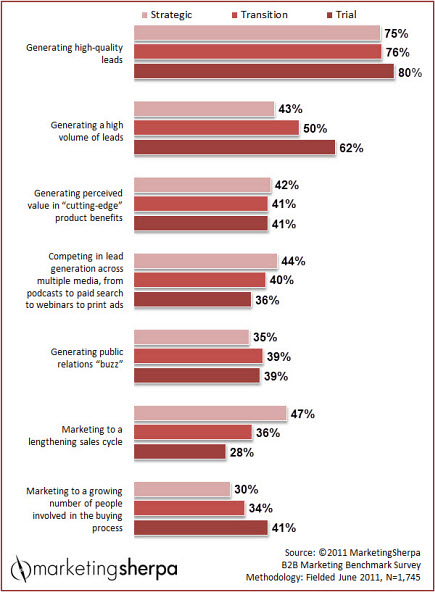
Click here to see a printable version of this chart
To help you understand the chart, in a previous Benchmark Report question, we asked marketers to describe the process their organization uses to plan, execute and measure the performance of lead generation, qualification, scoring, nurturing, hand-off/management and funnel optimization. The choices were:
- Strategic — Formal process, thorough guidelines, routine performance
- Transition — Informal process, few guidelines, sporadic performance
- Trial — No process or guidelines currently
All B2B marketers are challenged by generating high-quality leads
As you can see in the chart, generating high-quality leads is far and away the top challenge identified in the Benchmark Report.
While some challenges varied in importance based on marketing maturity — for example, 62% of trial-phase marketers were challenged by generating a high-volume of leads versus only 43% for strategic marketers; 47% of strategic marketers were challenged by marketing to a lengthening sales cycle, while only 28% of trial-phase marketers responded similarly — the spread was much tighter for this challenge, ranging from 80% of trial-phase marketers to 75% of strategic marketers recognizing this challenge.
So, we all know what the problem is … what is the solution?
Generating high-quality leads is an immensely difficult and complex problem to tackle, illustrated by the range of marketers recognizing this challenge. The ways to address it are equally varied and complicated. I don’t want to belittle the challenges you face every day in your job by touting an easy panacea — even if that tends to make for compelling article headlines that get shared widely across the Web.
Chart 4
"It's growing in popularity, but the overall cost and time that it takes to achieve results is less appealing than emailing and prospect emailing."
This quote comes from an e-commerce marketing manager responding to the MarketingSherpa 2013 SEO Marketing Benchmark Survey. It highlights the either/or view some marketers have of email and search marketing.
At first, there does not seem to be as obvious an overlap between these channels as there is with, say, search and social.
To identify areas of overlap, we needed to understand where marketers focused their search marketing time and resources. So in the survey, we asked:
Q: Which of the following SEO tactics has your organization used in the past year?
Click here to see a printable version of this chart
At first glance, this chart highlights one of marketers' key challenges. They're doing a lot. Even the least used tactic — digital asset optimization — is being conducted by 45% of marketers.
Since many marketers find it difficult to do less or gain more resources for the current workload, the only other option is better integrating the work that is already being conducted. So take out your silo-busting sledgehammer, and read these three ideas for combining your SEO and email tasks to get more done in less time.
Combo #1. Keyword and keyphrase research is email send planning in disguise
I know of a company (that shall remain nameless) struggling with getting its weekly event promotion email out every Wednesday.
They're too busy. Who has the time? Every week's send is a last-minute scramble. No time to optimize or test … just get-the-send-out-the-door-fast!
However, if you are one of the 88% of marketers who are conducting keyword and keyphrase research (that number is even higher — 91% — when we break out the data to marketers who have a dual B2B/B2C audience), what you’re really doing is finding topics where you can fill into a send calendar to plot out your promotional and content emails for the next quarter or even year.
If that keyphrase is relevant enough to your audience that they're searching for it, it should be relevant enough for their inbox, as well.
Once you have those topics planned (and last-minute tweaking is always possible, of course), you can start keeping your eye out for products, content, promotions, graphics, news stories, testimonials and the list goes on that you can slot into that calendar — so as the send approaches, you have a lot of information to work off of.
BONUS: Subject lines are one of the hardest things to get just right and can take up a lot of time with tweaking and last-minute refinements. People don’t just type keywords into search engines. The right keywords also reflect prospect interest. If you already have those in your email calendar, adding them to your subject lines (and even better, testing those subject lines) can lead to more opens and faster subject line writing.
Combo #2. Content creation feeds both Google and Gmail
Yahoo and Yahoo Mail. Bing and Outlook. I’m not trying to play favorites here. My overall point is that inbound and outbound can benefit from each other, will help you create one integrated process, and save you time.
A VP of Marketing responded to the benchmark survey by saying, "We don't have a process as of now; we're focused on outbound tactics. However, I have been reading about inbound and content marketing, which seems to have reached 'frenzy' status. We engaged in discussions and presentations with [vendor name removed] to replace our current email provider."
Chart 5
Where do you produce content to help with SEO? What channels might have you overlooked?
Marketers often like to get a sense of where their peers focus their resources, so in the 2013 MarketingSherpa SEO Marketing Benchmark Survey, we asked marketers about where they produce content for search engine optimization …
Q: What mix of content products do you currently use as part of your total SEO marketing strategy?

Click here to see a printable version of this chart
Not surprisingly, the place most marketers focus their content-producing efforts is on webpages. The website, with its landing pages, is still the hub of conversion for many marketers, so many marketers focus on getting their webpages to rank highly by producing content directly on them.
Social media and blogs are also used by a large majority of marketers, likely to help produce fresh content for search engine spiders, as well as strengthen the social graph signals that search engines are measuring.
If we break down the data and look at B2C marketers, they focus far less on whitepapers and case studies (10% and 9%) than their B2B and B2G peers (52% and 51%). However, B2C marketers focus much more on customer reviews (44% for B2C versus 27% for B2B).
With only 8% of marketers using podcasts as part of their SEO strategy, it begs the question if this channel is being overlooked. After all, podcasts can be transcribed and serve as the source for content-rich landing pages, especially helpful for long-tail search.
But much more than that, podcasts are a way to increase engagement and help move your prospects through the funnel.
This is an important consideration when choosing which channels to invest your content budget in — think beyond just SEO. Sure, organic search is valuable and will help ensure more possible customers interact with your content.
But, SEO shouldn't be the only consideration. At the end of the day, if your content isn't helping your customers through the channels they want to use, whether that is a webpage or a digital magazine, you likely aren't meeting your ultimate objective — ROI.
Chart 6
Usage of a lead generation tactic can sometimes be driven by the hype surrounding it. Other marketers take an unbiased view of the tactic, and gauge its effectiveness versus its difficulty.
So, we asked marketers the following three questions, and combined them into one chart to balance these considerations …
Q. Which of the following lead generation tactics does your organization currently use?Q. Please indicate the LEVEL OF EFFECTIVENESS (in terms of achieving objectives) for each of the lead generation tactics your organization is using.Q. Please indicate the DEGREE OF DIFFICULTY (time, effort and expense required) for each of the lead generation tactics your organization is using.
Click here to see a printable version of this chart
As you can see, search engine optimization was considered the most effective tactic, but also among the most difficult. However, it is not as difficult as another highly effective tactic (and important component of SEO) — content.
Trade shows are considered more difficult than content. Although, even with the physical logistics issues surrounding trade shows along with the difficulty of sticking out on an often-crowded expo floor (not to mention the challenge of coming up with the coolest free swag), trade shows were rated as barely more difficult than content.
On the flip side, email marketing was considered both among the most effective and least difficult tactics. Not surprisingly, it was also highly used. Mobile marketing, still an emerging tactic (although one that should go hand-in-virtual-glove with email) is among the least used tactics. Somewhat surprisingly, given its relative newness to most marketers, it was only considered about mid-range in difficulty.
One of the biggest opportunities appears to be in webinars (another subset of the highly difficult content marketing). While marketers struggled somewhat with content, they did find webinars much easier. Combining that with their high degree of effectiveness and relatively low rate of usage (in other words, less competition for your webinars), they could be a tactic worth looking into for your lead generation planning if you do not already utilize them.
Points to consider
Use this data, and the following questions, to help your marketing department evaluate its efforts.What challenges do you face with your SEO? Is it purely around the technical challenges of your website, or do you also struggle with the relationships necessary for link building or the content that must feed the beast?
What challenges to you face with creating content? How do you plan to overcome them? Do you have a dedicated writer(s) or content creator(s) on your marketing team, do you outsource your content creation to a freelance writer(s) or an agency? Or is your marketing team responsible for generating its own content?
Do you overlook relatively laggard techniques like print advertising simply because they don’t generate as much hype in the industry? While it has a low level of effectiveness, might its low level of difficulty and usage (competition for eyeballs) make it a worthwhile tactic to explore?
Share your experiences with the MarketingSherpa community
Use the above questions internally with your own team to help improve your lead generation efforts, and also share your actionable advice and inspirational stories on the
MarketingSherpa LinkedIn Group discussion about this chart for a chance to be featured in a future blog post.
Chart 7
In previous Charts of the Week, we took a look at
the most commonly used types as well as
the most effective types of content to produce. In today's Chart of the Week, we will explore the most difficult types of content.
To discover which types of content most challenge marketers, we asked the following question in the 2013 MarketingSherpa SEO Marketing Benchmark Survey …
Q: Please indicate the DEGREE OF DIFFICULTY (time, effort and expense required) in creating each of the content products your organization is using.
Click here to see a printable version of this chart
Images were the easiest content to produce for marketers, with 73% considering images to be "not difficult." Interestingly enough, images were also the only type of content listed that do not require words or writer.
When we looked at what content was most difficult for marketers, two trends emerged.
Technology and production was considered a challenge, with 26% of marketers saying online video and mobile apps are both very difficult, and 80% of marketers considered these tactics to be somewhat or very difficult. Both tactics require heavy non-content inputs. In the case of mobile apps, that is IT resources. In the case of online video, video production resources.
Long-form, in-depth content was also a challenge — 26% of marketers considered white papers very difficult, and 78% considered white papers very or somewhat difficult. Other long-form, in-depth content — case studies, e-books, and webinars/webcasts — rounded out the most difficult tactics.
No significant differences between primary sales channels
While we found differences between primary sales channels concerning the effectiveness of content — for example, B2C marketers favor webpages, while B2B marketers favor webinars — marketers were fairly unanimous on their content challenges, or lack thereof.
When we broke down the data, marketers who identified themselves as B2C, B2B and/or B2G, as well as both B2C and B2B all ranked images as the least difficult content, and online video as the most difficult.
For B2B and/or B2G marketers, white papers and case studies ranked right up there for difficulty with online video, with 28% of marketers finding white papers very difficult (80% somewhat or very difficult) and 31% of marketers finding case studies very difficult (74% somewhat or very difficult).
Too few B2C marketers responded about the difficulty of these efforts to constitute a valid sample size, so an apples-to-apples comparison is difficult to make. Of course, that is a significant piece of data in and of itself. When we asked B2C marketers about usage of different content types, only 10% used white papers and just 9% used case studies. Since B2C marketers tend to have a more direct sales path, versus the complex sales path for many B2B marketers, less usage of long-form, complex content makes logical sense.
Are there any content diamonds in the rough?
When we compare this week's chart about content difficulty to previous charts about usage and effectiveness, we see that webpages are considered both quite effective and not too difficult, and they are, not surprisingly, also the most used type of content.
It should also be noted there are many types of content, like case studies for example, that are considered effective, but also difficult, so their usage rate is lower.
But, where is the low-hanging fruit? Are there effective, easy-to-execute types of content marketers are overlooking?
Customer reviews stick out as one possible diamond. While 43% of marketers consider this tactic to be very effective, and 92% of marketers consider it to be very or somewhat effective, only 35% of marketers are using customer reviews. And yet, as you look at the difficulty data in the chart above, you'll see that 54% of marketers consider customer reviews to be not difficult, with only 12% of marketers rating this tactic as very difficult.
Chart 8
As we learned in the 2012 Mobile Marketing Benchmark Survey, of the surveyed marketers who do test mobile campaigns, more than 10% of their efforts go into mobile optimization and testing. We wanted to know how marketers were implementing mobile testing, so we asked …
Q: How routinely does your organization implement the following testing practices?
Click here to see a printable version of this chart
In terms of establishing routine testing practices, 59% of respondents indicated they routinely, or somewhat routinely, adhered to the tried-and-true practice of maintaining annual benchmark reports. However, just 43% said their companies routinely, or somewhat routinely, utilize a specific testing methodology.
Despite the rapid growth of mobile as a primary communications tool for businesses and consumers alike, just more than half (51%) of respondents indicated they regularly brainstormed challenges and opportunities within this burgeoning channel.
Further in the
2012 Mobile Marketing Benchmark Report, when asked about their companies' testing of specific mobile campaign elements, the landing page was the predominant selection, followed closely by mobile device and target audience.
Points to Consider
Do you invest in measurable, repeatable testing methodologies, or rely on less regularly documented data? What elements of mobile marketing practices do you feel make it difficult to establish routine testing procedures?
For more information about mobile marketing, download the free excerpt from the
2012 Mobile Marketing Benchmark Report. And, be sure to share your own analysis of this chart in the
MarketingSherpa LinkedIn Group for a chance to be published in a future blog post.
Chart 9
In fielding the 2013 Email Marketing Benchmark Survey, we received a comment from Brian Reich, Managing Director, little m media, in which he said, "It's not worth sending an email unless there is content worth reading, sharing and discussing. Our ability to source content that has value to our audience(s) and/or create that content ourselves will determine our email marketing strategy."
Indeed, marketers can help determine an email’s value through recipient engagement. But, how are marketers garnering this engagement? To find out, we asked …
Q: Which of the following tactics is your organization using to improve the relevance and engagement of email content delivered to subscribers?
Click here to see a larger, printable version of this chart
The most-used tactic for improving customer email engagement was the automatic, triggered email — 39% of our respondents claimed these triggered auto-sends helped improve relevance.
Behavior-based segmentation (37%) and dynamic personalization (36%) were also widely used among surveyed marketers.
Interestingly, tactics that are often used to create a more interactive experience, such as gamification (18%), reward programs (14%) and images/video (11%), were much less commonly used than the afore-mentioned segmentation strategies.
Points to Consider
How have triggered emails performed for your organization, in terms of improving customer email engagement? Do you feel this level of segmentation is ample enough to provide an engaging experience for your readers? How do gamification and/or rewards programs factor in your future email planning?
For more information about email marketing, download the
free excerpt from the 2013 Email Marketing Benchmark Report. Be sure to share your own analysis of this chart in the
MarketingSherpa LinkedIn Group for a chance to be published in a future blog post.
Chart 10
As we learned in the
2013 Email Marketing Benchmark Report, our survey respondents overwhelmingly believed email was viewed by their organizations as a producer of strong ROI. To build upon these findings, we also asked marketers …
Q: What is the estimated ROI from email marketing programs for your organization?
Click here to see a larger, printable version of this chart
When asked to estimate their email programs' return on investment, our surveyed marketers claimed an average ROI of 119%, with B2B and/or B2G marketers claiming the highest return at 127%.
A notable disparity was found when breaking down this data by overall email volume. According to our respondents, organizations that sent more than 100,000 emails per month estimated a 94% average ROI, while those who sent fewer than 100,000 messages per month averaged 139%.
In a subsequent question in the Benchmark Report, we asked respondents how they believed budget allocations would shift for 2013. Of those who responded, 64% indicated their organizations' investment in email marketing was expected to increase.
Points to Consider
Have you experienced ROI for your email spends similar to these? To what would you attribute any substantial differences? Have you noticed any discernible patterns of ROI that you’d attribute mostly to the number of messages sent? How have your ROI results affected future budgeting?
For more information about email marketing, download the
free excerpt from the 2013 Email Marketing Benchmark Report. Be sure to share your own analysis of this chart in the
MarketingSherpa LinkedIn Group for a chance to be published in a future blog post.