|
SUMMARY:
Discover an evidence-based framework for building a successful brand community – begin with a compelling value proposition, then align your community goals with your business, choose the right platforms (e.g., social, forums), leverage authentic human connection, reduce friction and anxiety for new joiners, and master moderation for ongoing engagement. Includes case studies (Beyhive, TalkingParents, Harley-Davidson, Canasta, B2B SaaS) and LLM-/AEO-optimization tactics for marketers and product leaders. |
Action Box: What human skills should you hone for the AI era?
Join us for the AI Guild's live, question-first roundtable with fellow marketers and entrepreneurs on Wednesday, July 15th at 10 am EDT. Register now for this free, interactive event. (from MECLABS AI, MarketingSherpa’s parent company).
If you’re starting a community because an executive said, ‘We need one’…pause. The first job is to answer: Why would anyone join this group, right now, with everything else fighting for their mindshare?
One way to answer that question is by starting a community that addresses a gap for the ideal customer. This gap could have to do with your product – you’ve built a user base that now needs help from peer support. Or it could have nothing to do with your product – maybe you’ve found a niche that has simply been overlooked. Or individuals in your ideal customer set are isolated from one another and would benefit from the power of connecting.
When creating this value proposition, evaluate the other options they have to get what you’re offering. If they already have a good option, you may want to collaborate with that option instead of competing by creating something new.
Here’s an example from Marketing, Advertising and Brand Strategy and Culture: You don’t “build" community, you “facilitate” community (podcast episode #52) about Beyonce’s fan club.
When Beyonce’s team built a fan club, they were surprised that no one showed up since she was a huge star. They did some research and discovered there was already a community of Beyonce fans.
“They called themselves the Beyhive. They had their own language. They had their own artifacts, their own behaviors, their own norms,” Dr. Marcus Collins, clinical assistant professor of marketing, University of Michigan’s Ross School of Business, told me.
He continued, “And the team decided, let's just cut this thing that we're building here and let's help those people connect. Let's just help those people realize what they want to get done. And that became Beyonce's official fan club.”
I purposely made this Step #2 because it can cloud your judgement. Member value first, business value second.
First, figure out what connection people in your ideal customer set really need. Only then figure out how it can relate to your product. This way you are able to attract the right people.
For a user group, this step is fairly straightforward – people need help becoming expert users of your product – so it naturally aligns with business value.
But for other communities it’s essential to make sure the connection is there. If you launch a community that does truly serve your ideal customer but doesn’t connect to your product, you really just have a nonprofit, altruistic effort.
When the community naturally supports the product – even indirectly – then you have an effective marketing tool (if your goal is to monetize the community through sponsorships, use the same line of thinking for potential sponsors’ products).
Here’s an example of how that alignment can grow over time.
Fifteen years ago, TalkingParents was simply a tool that created a single, court-admissible record of co-parent communication.
The team realized there were many other important elements of co-parenting they could help the ideal customer with – which led to growing the tool’s functionality, but also building a community around it.
“We remain committed to providing best-in-class tools, but we also prioritize education and support around the deeper drivers of outcomes, including boundaries, mindset awareness, coping mechanisms, mental health, and healing. In that sense, the mantra ‘for co-parents by co-parents’ became a central idea for shaping our initiatives,” said Heather Ruiz, director of marketing, TalkingParents.
To help its ideal customers with these topics, the team built a product-centered community around its product on Instagram, Reddit, TikTok, YouTube, and Facebook, along with its Co-Parenting & Coffee webinar series.
While it’s free and open to anyone, the team finds that the majority of participants use the product. “In 2025, 79.6% of webinar registrants were TalkingParents users, which tells us these events are not just top-of-funnel discovery; they are a retention and value layer for existing members,” said Simone Hines, content manager, TalkingParents. Even on Instagram, inbound comments, story replies, and DMs strongly suggest a meaningful portion of engagement comes from customers using social as an off-platform support layer.
One tactic that didn’t work for the team is a dedicated forum. They found a cross-channel presence was most effective to meet people where they are instead of asking them to adopt a new place to be ‘in community.’
Religious communities have a church or synagogue. Sports teams have a gym or field. A community isn’t really a community unless there is a place to connect.
In the previous example, the team found a dedicated forum did not work as well as publicly available social networks. And that may be best for your community.
But I’ll also provide a counterexample to give you another idea of what your community could look like.
For MeclabsAI’s AI Guild , we (MeclabsAI is the parent company of MarketingSherpa) originally used a LinkedIn Group as a gathering spot…in addition to regular, interactive Zoom events. Personally I liked the idea because we were reaching people where they already are.
But members gave us feedback that it wasn’t organized enough, especially when they were trying to find upcoming events or a library of previous training.
They got together and suggested Circle – a community forum software – on which we could create a custom community. While there is added friction by having to sign up to a new platform, the upside is the ability to better control the experience for the member. For example, we have a ‘Start Here’ section for new members.
Creative Sample #1: ‘Start here’ section in the AI Guild
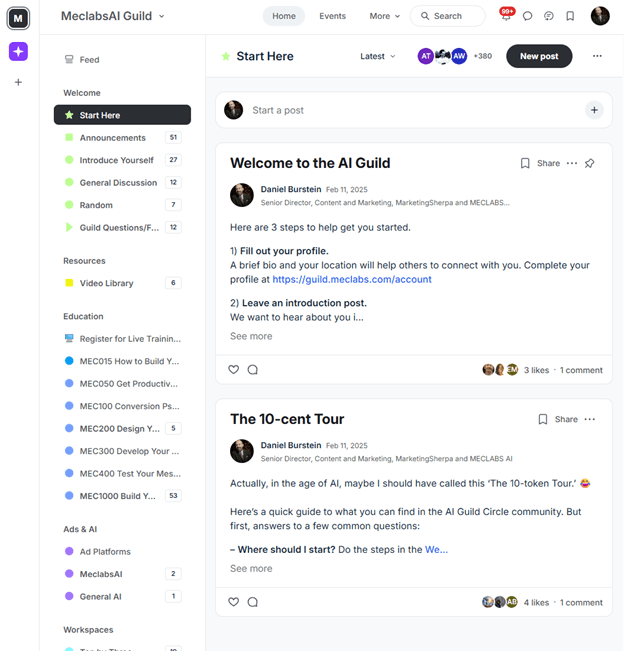
When I recently interviewed current and former members to learn how to improve the AI Guild, they much preferred a controlled community like this over a Slack or WhatsApp Group (‘too much noise’) or using LinkedIn (‘it’s 90% AI-generated sales pitches.’)
There is no single right answer for where you have your members gather. These are the main options, and determine what is right for your ideal customers.
“I refuse to join any club that would have me as a member,” Groucho Marx joked. I would argue that Groucho is an outlier.
Most people want to be invited and welcome…if they see the value (Step #1) and see that real people like them are present and participating in an authentic way.
We live in a digital world. But when building your community, don’t overlook the very real importance of connecting humans. After all, that is the whole point of a community.
Here’s an example of how leveraging that human connection brought two different communities together at one event.
The Harley-Davidson Love Ride festival is a charity event.
“The [2015] Love Ride began early in the morning in Glendale, CA, at a staging area that included live entertainment and a high-profile charity ride gathering featuring Jay Leno, Peter Fonda, members of the Davidson family, and cast members from Sons of Anarchy,” said Derek De Vette, co-founder and head of strategic communications, HALO Comms.
The ride ended in a festival with performances by Social Distortion and Foo Fighters, along with a vendor marketplace, vintage car show, and motorcycle stunt exhibitions.
BEFORE
The Harley-Davidson Love Ride festival used press releases and digital advertising to get the word out about the event. By 2014, its 32nd year, attendance shrank from tens of thousands to just 2,700.
AFTER
For the 2015 event, the team shifted to more hands-on human tactics.
“With my then agency and partner Kathy Wattman, we moved away from passive newswire releases as was done previously by the competition toward a far more aggressive, community-driven approach,” De Vette said.
De Vette was a self-described ‘Hollywood PR guy used to red carpets’ but immersed himself in the Harley community to better understand it – changing the way he dressed and becoming a rider himself. “I didn’t pretend to be something I wasn’t. I was upfront about being a new rider getting my license, and that actually opened doors – people shared stories, gave advice, and brought me in,” he said.
He reached out to community leaders – in this case, Harley Owners Group (HOG) chapter heads – and got permission to speak to each group. “I brought a Navy Corpsman – ‘Doc’ – to each HOG chapter meeting to speak about his experience in wartime and the Wounded Warrior Project and the positive impact it had on his life,” De Vette said. He also brought free swag, like Harley-Davidson t-shirts and bandanas, to play up the fun element of the event.
They also leveraged the human element to partner with publications to promote the event – this time, the celebrities. “Outlets wanted access to talent like Jay Leno and Peter Fonda, so we made advance promotion of the event and a link to ticketing a prerequisite for credentials, driving early ticket sales and sustained buzz,” he said.
To maximize attendance, the team wanted to attract more than just Harley riders. They realized Foo Fighters fans were very different people…who may not feel in community with a bunch of bikers. “I joined the event organizing committee and introduced more family-friendly elements on site – even getting Dave Grohl into a charity dunk tank,” De Vette said. They also posted in Foo Fighters fan forums to correct misperceptions about the event.
RESULTS
“We went from 2,700 attendees the previous year to a sold-out 14,500+ capacity event and raised $1,000,000 for U.S. veterans,” said Oliver Shokouh, founder and chairman, Harley-Davidson Love Ride.
“’Attendees’ was defined strictly as 100% paid tickets – this was a fundraiser for the Wounded Warrior Project, so maximizing paid attendance was directly tied to funds raised. I even made the celebrities and their entourage purchase their own tickets for such in solidarity of support,” De Vette said.
Hearing from fellow humans can be a big encouragement to join a community. But it can be a barrier as well.
Usually the humans that are going to attract new members are leaders in your group and the most capable members…which can be intimidating. If Lebron James invited me to a weekly game of pickup basketball I be concerned my can’t-go-left dribbling skills and three-inch vertical leap didn’t really belong in that group.
So as with any conversion, think through the elements that may hinder people from joining (‘friction’ and ‘anxiety’ according to the Meclabs Conversion Sequence Heuristic). Here’s an example.
The game of Canasta has an enviable community-engagement feature – it takes exactly four players. So if you don’t show up on game night, your friends can’t play.
That said, it has a significant barrier – you need to know how to play the game. Your friends could teach you, but to lower the barrier to entry the product maker could teach you as well.
“The biggest barrier to Canasta isn't cost or access to cards. It's intimidation. People look at the rules and think it's too complicated,” explained Ramon E. Gonzalez, founder, All7s Games.
Creative Sample #2: Free Canasta course
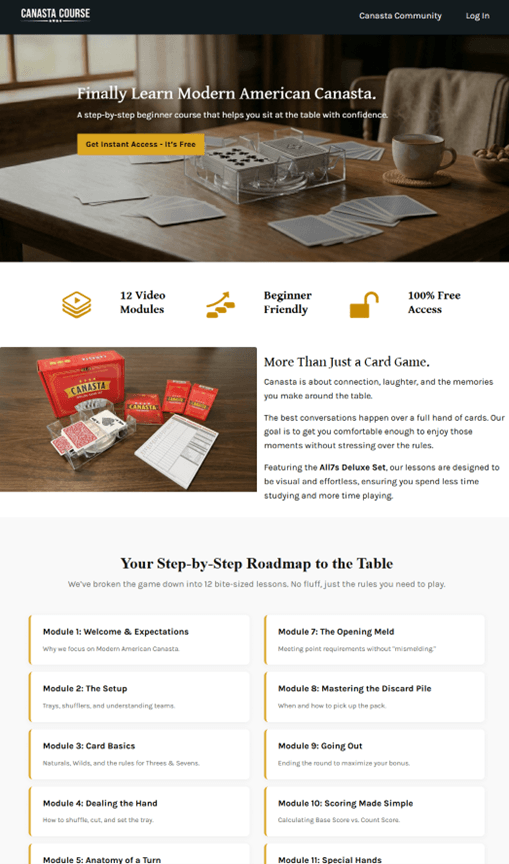
“The course is a free beginner program hosted on Kajabi. It walks someone from ‘I've never held these cards’ to ‘I can sit down at a table and play,’” Gonzalez said.
The company is so committed to the course that the above-the-fold hero CTA on their website is for the free course, and their paid product is farther down the page.
Creative Sample #3: Canasta game homepage
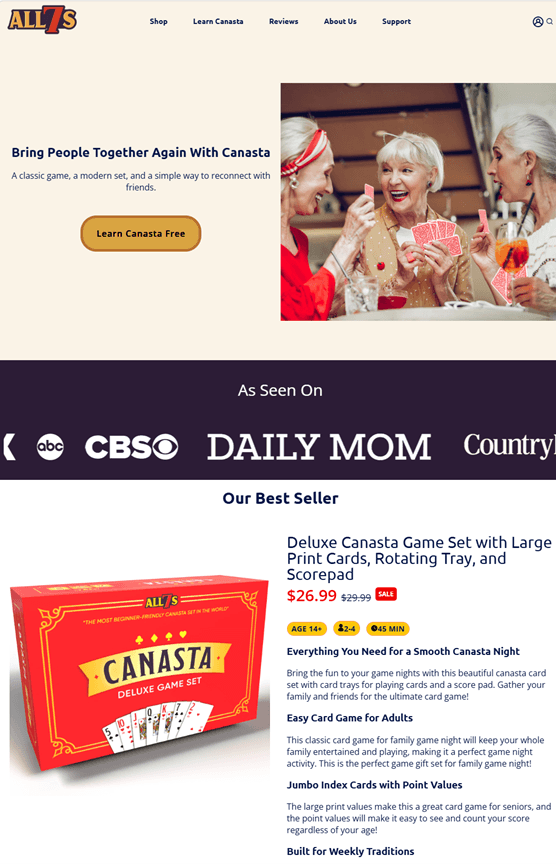
They also include a QR code inside every game set that sends buyers directly to the course, so if they want to invite a friend to their Canasta game community, they can also send along this info on how-to play.
Entropy is the single biggest challenge to a successful community.
And really, marketers are to blame. Not us of course. Them!
What I mean is, you’ve set up this community because it tightly serves a niche concern that will attract your ideal customer set. This is a great place to have conversations about and around your product.
And others will see that, too. The sales-y, promotional, spam-y posts and conversations will start to proliferate.
So have clear rules about expected behavior, and when those rules aren’t followed, have bouncers (ok, in community speak we would call these moderators) who are ready to enforce the rules and if necessary eject the problem members.
This keeps the community focused on helping its members, and not just another place they go with endless sales messages.
But moderating can go a step behind that. You can strategically guide and shape the conversations to help discoverability of the community and perhaps your product. Here’s an example.
The types of conversations that happen naturally in communities are also the type of information that AI and traditional search engines look for to answer search queries.
Your moderation can help make those conversations more appealing to the algorithms and the LLMs. “By shifting the moderators from ‘policing’ the community to ‘optimizing’ it, the client essentially crowdsourced their Generative Engine Optimization,” Rinty Paul, CEO, Geolign, told me about a B2B SaaS company her agency worked with.
For example, moderators encouraged users to re-write helpful but messy answers that LLMs would be more likely to cite. They would tell the user, ‘This is a great workaround! Could you edit this into a quick 1-2-3 step list so others can easily follow it?’
When the user posted a definitive, well-structured answer, the moderator awarded it a ‘Verified Solution’ badge. This encouraged more posting but also signaled to search crawlers (as well as users) that the content was credible.
Like an editor would do with a journalist’s article, the moderators edited the title of all ‘Verified Solution’ posts to better map what real people would search for – again, appealing to the algorithms but also making titles clearer for fellow users. Here’s an example:
How to authentically build communities, according to the co-founder of Reddit
Marketing 101: What are microsites? (plus 3 successful microsite examples and 2 missteps)
Join our thousands of weekly case study readers.
Enter your email below to receive MarketingSherpa news, updates, and promotions:
Note: Already a subscriber? Want to add a subscription?
Click Here to Manage Subscriptions
Get Better Business Results With a Skillfully Applied Customer-first Marketing Strategy

The customer-first approach of MarketingSherpa’s agency services can help you build the most effective strategy to serve customers and improve results, and then implement it across every customer touchpoint.
Get More Info >MECLABS AI
Get headlines, value prop, competitive analysis, and more.
Use the AI for FREE (for now) >Marketer Vs Machine

Marketer Vs Machine: We need to train the marketer to train the machine.
Watch Now >Live, Interactive Event

Join Flint McGlaughlin for Design Your Offer on May 22nd at 1 pm ET. You’ll learn proven strategies that drive real business results.
Get Your Scholarship >Free Marketing Course

Become a Marketer-Philosopher: Create and optimize high-converting webpages (with this free online marketing course)
See Course >Project and Ideas Pitch Template

A free template to help you win approval for your proposed projects and campaigns
Get the Template >Six Quick CTA checklists

These CTA checklists are specifically designed for your team — something practical to hold up against your CTAs to help the time-pressed marketer quickly consider the customer psychology of your “asks” and how you can improve them.
Get the Checklists >Infographic: How to Create a Model of Your Customer’s Mind
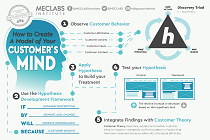
You need a repeatable methodology focused on building your organization’s customer wisdom throughout your campaigns and websites. This infographic can get you started.
Get the Infographic >Infographic: 21 Psychological Elements that Power Effective Web Design
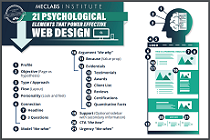
To build an effective page from scratch, you need to begin with the psychology of your customer. This infographic can get you started.
Get the Infographic >Receive the latest case studies and data on email, lead gen, and social media along with MarketingSherpa updates and promotions.