|
SUMMARY:
Your prospects aren’t Googling ‘fractional CFO.’ They’re muttering, ‘Why is cash always tight?’ So when you lead with the symptom they already feel, you earn attention. In this article we show you how to win over those prospects by naming the problem in their words, then guiding their thinking. Read on for specific steps illustrated with real-world examples from your peers. |
Action Box: Grow your client base with an intelligent intake agent
Enter your website URL and Easy Agent Builder will email you a custom, ready-to-embed intake/sales chat agent trained on your site. You’ll get $100 free credits to use it. No credit card required (from MECLABS AI, MarketingSherpa’s parent company).
Most of your ideal prospects don’t care yet – because they don’t recognize the problem yet. And that’s one reason we have marketing, right?
Yes, deeper into the customer journey, it makes sense to show why your firm is better than competitors. And some companies can build a good business on focusing only on these high-intent buyers – people who know they have a problem and are actively looking.
But there are likely many, many more of your ideal customers who are not even thinking about the problem your company can solve. If you try to reach them with your typical high-intent messaging (how your firm does X, or is better than Y and Z alternatives) you will be sending the wrong message to the right person, because they do not care…yet.
So allocate some of your marketing budget to building the problem.
Name the problem in the prospect’s language. Remember, they don’t care about the thing you sell, they care about the problem or goal they have. So for example:
To find the phrase that pays, look through sales call notes, support tickets, reviews, and proposal objections…or better yet, actually talk to these fellow human beings at in-person events or on dedicated calls.
When using the prospect’s language, you’ll often be focusing on symptoms of the bigger problem your firm solves, not the problem itself. So listen for phrases like ‘I’m worried that…’ or ‘I hate when…” These are triggers that help you find a symptom that can open the prospect’s mind to see that there is a larger problem they face that they need help with.
Just like with a shark, you know it’s there when you see the fin even if you haven’t stuck your head in the water to see what lies beneath. Symptoms are the ‘visible fin’ that signals a deeper problem.
As Flint McGlaughlin, CEO, MECLABS AI, teaches (see: three letters to drive subject line success), you should ask three questions to find the most effective symptoms:
(MECLABS AI is MarketingSherpa’s parent company)
Now that they understand their company has the symptoms you’ve identified, this leaves a small opening for your firm to provide some help.
Call it thought leadership if you want. Practically, it’s diagnostic clarity delivered before a sales conversation.
Your prospect needs help with problem framing to help them understand the real issue. To use an example I’ve seen many times coaching in MECLABS’ AI Guild, marketers or entrepreneurs would worry they had a problem with their headline or landing page. But that was just a symptom. The real problem was with their value proposition.
Once you’ve framed the problem, provide a diagnostic insight. The goal of providing a way of thinking combined with a small actionable insight is to become a trusted guide.
If the prospect sees you can teach them how to think about the problem, you are starting down the path of getting hired to solve the problem.
A big problem at this stage is making it tangible. Here’s an example.
Most prospects we want to reach are already being inundated with email spam, cold calling, and LinkedIn outreach. How do you stick out from that crowd and get your foot in the door?
“The direct-mail campaigns for myself and my clients have included…physical objects connected to the recipient’s specific commercial problem, followed by coordinated digital and phone outreach,” said Jordan Japal, founder, Sax Sells.
For one client’s campaign, Japal sent sandpaper to represent friction points within a prospect’s digital customer journey.
Creative Sample #1: Dimensional direct mail piece with sandpaper
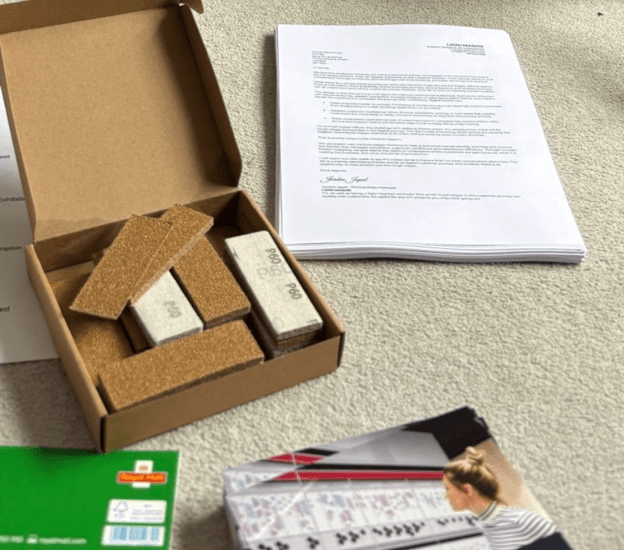
Once they’re framed the problem with a dimensional direct mail piece, then the team turns to digital messages. “Follow up over six to eight weeks using calls, voicemails, emails and LinkedIn messages,” Japal said.
RESULTS
This is an ongoing campaign. The team sent it to 50 leads, and plan on doing another 50. They’ve had six positive responses (12% response rate) so far.
According to the MECLABS Strategy Compact You are the foundation (and you are the ceiling), an unclear value proposition is one of four common revenue leaks in professional services. “Can a prospect say, in one sentence, why you and not the firm across the street? When clarity is missing, prospects stall, comparison-shop, and default to price.”
State the primary reason the ideal prospect should choose your firm. It’s the bridge between the problem you built and taking the first step with your firm.
And make sure you focus on the right level of the value proposition. Many companies default to focusing on the overall value proposition of the company, when the next action they want the prospect to take is a consultation call. You can see an example of how to transition that value prop messaging in How Aetna’s HealthSpire startup generated 638% more leads for its call center.
A process-level value proposition is the answer to the question: ‘If I am [type of ideal prospect], why should I [take the action you’re asking] rather than [any other action I can take]’?
Here are some example first steps you might ask prospects to make, complete with templates for how you can begin to build a process-level value proposition around each (these templates help you with clarity, exclusivity, and appeal, in Step #4 we show you how to layer on credibility).
Discovery call
Because we only book these when there’s a reasonable chance [based on specific IP and/or experience] we can create meaningful clarity in a single conversation. In [15/20/30] minutes, we’ll ask a focused set of questions to isolate the likely drivers behind [symptom in their words] and leave you with (a) the 1–2 most probable root causes, (b) what to do next (even if you don’t hire us), and (c) whether we’re the right fit to help.
Diagnostic assessment
Because our [Assessment Name] is a structured diagnosis that turns ‘we think we have a problem with [symptom]’ into a prioritized, evidence-based plan. You’ll receive a short, written brief with what’s happening, why it’s happening, and the highest-leverage fixes. The assessment is created by [senior team/partners] based on [specific, tightly relevant experience].
Audit
Because in the [Audit Name], we review [asset(s)] using a consistent checklist based on [specific intellectual property/experience] to identify the specific points of friction, risk, or waste that are costing you results. You’ll get a prioritized punch list – what to change, why it matters, and what ‘good’ looks like – so your team can act immediately…whether you hire us or not.
Strategy workshop
Because this workshop is a working session led by [senior leader(s) with specific, tightly relevant experience] designed to help you create alignment and make decisions. We’ll map [goal], identify constraints, pressure-test assumptions, and finish with a one-page strategy: priorities, message, sequence, and next actions. The outcome is clarity and alignment.
Proof-of-concept
Because our pilot is designed to reduce risk based on [description of previous, similar engagements]. We define success metrics up front, run a time-boxed test on [scope], and deliver a readout that answers: Did it work? What did we learn? What should scale? If it doesn’t meet your threshold, you stop with learnings – not a long contract.
Second opinion
Because you can bring us your current plan/proposal and [senior leader with specific, relevant experience] will review it for hidden assumptions, risk, and missed alternatives based on [description of previous engagements or intellectual property]. We’ll tell you plainly where it’s solid and where it’s vulnerable. You’ll leave with questions to ask, red flags to watch, and what to validate next.
At this point, your prospects have an understanding of their problem/goal and how your firm can begin to help them solve the problem or reach the goal.
Now you need to instill belief that you can come through and deliver. You need to show them some proof – like evidence, credentials, process transparency, etc. – to earn enough confidence that prospects are willing to take the next step with your firm.
Your proof should be relevant (why this matters to a precise ideal prospect) and specific (for example, you could include details of the execution, restraints, numbers, and names when possible).
Here’s an example to get you thinking.
BEFORE
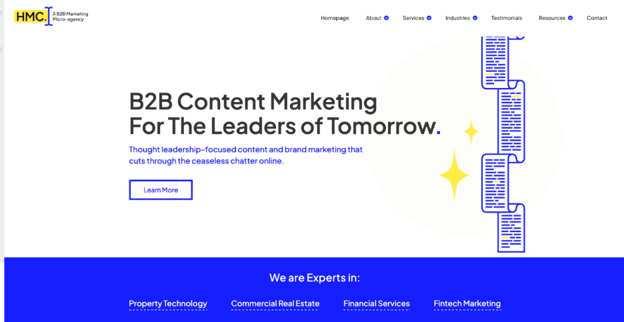
The homepage for HMC (Hannah Miet Consulting) led with generic, industry-agnostic positioning – ‘B2B Content Marketing For The Leaders of Tomorrow.’
Creative Sample #2: Previous homepage hero section for B2B thought leadership consultancy
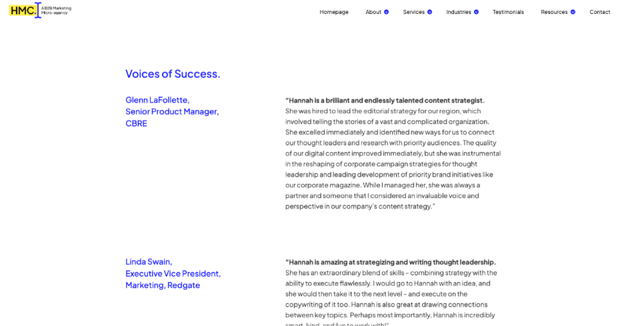
The homepage had testimonials, but they weren't tied to any specific, quantified result. For example, ‘Hannah is a brilliant and endlessly talented content strategist.’
Creative Sample #3: ‘Voices of Success.’ Testimonial section on B2B thought leadership consultancy’s previous homepage
AFTER
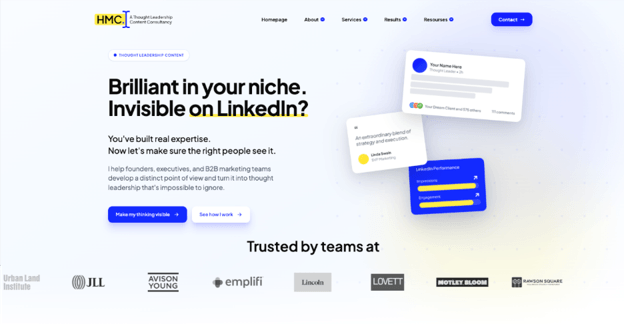
When Miet redesigned the homepage, she started by building the problem (as discussed earlier in this article). The new headline read, ‘Brilliant in your niche. Invisible on LinkedIn?’
While many changes were made to the site, a bigger focus on relevant proof was one of the most consequential changes. She moved client logos directly under the hero in a ‘Trusted by teams at’ section – before any info about her company.
Creative Sample #4: New homepage hero section for B2B thought leadership consultancy
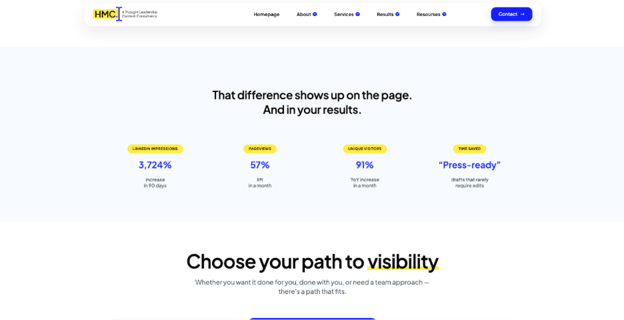
Miet added specific results her consultancy generated for clients to the homepage. For example, a 57% pageview lift.
“This [statistic] came from Avison Young’s U.S. Viewpoints thought leadership campaign,” said Hannah Miet, owner, HMC. “The client themselves submitted these analytics, quotes, and results on Clutch as a review of my business.”
Creative Sample #5: Client results section on new homepage for B2B thought leadership consultancy
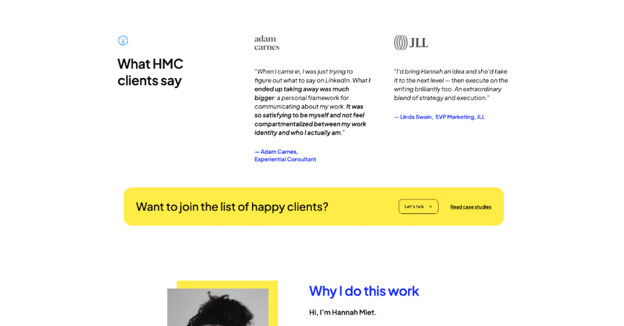
She also used shorter testimonial quotes that were more tightly tied to a specific outcome. For example, ‘What I ended up taking away was much bigger; a personal framework for communicating about my work.’
“This [testimonial] came from a client [Adam Carnes] who was in my 6-month, one-on-one positioning and LinkedIn coaching program,” Miet said.
Creative Sample #6: Client results section on new homepage for B2B thought leadership consultancy
RESULTS
The first week the new site went live, it generated 10 contact-form submissions. The previous week, the old site had zero submissions (as did most weeks before the site overhaul).
This article was distributed through the free MarketingSherpa email newsletter.
Related resources
Marketing for Business Services: When the world changed, so did we (podcast episode #141)
The New Economics (and Philosophy) of Value in the AI Era – Wednesday, September 2nd at 10:00 am EDT
How a Visionary Law Firm is Doubling New Client Intake
B2B Growth Killers: How 3 companies identified friction that hindered results
AI transparency
This is a human-conceived and -written article, assisted by AI. MeclabsAI was used to review source pitches for artificial intelligence usage, evaluate the credibility of potential sources, craft follow-up questions to sources, brainstorm the steps and advice in this article, create Open Graph and CMS thumbnail images, and provide copy-edit suggestions for the article.
Get Better Business Results With a Skillfully Applied Customer-first Marketing Strategy

The customer-first approach of MarketingSherpa’s agency services can help you build the most effective strategy to serve customers and improve results, and then implement it across every customer touchpoint.
Get More Info >MECLABS AI

Get headlines, value prop, competitive analysis, and more.
Use the AI for FREE (for now) >Marketer Vs Machine

Marketer Vs Machine: We need to train the marketer to train the machine.
Watch Now >Live, Interactive Event

Join Flint McGlaughlin for Design Your Offer on May 22nd at 1 pm ET. You’ll learn proven strategies that drive real business results.
Get Your Scholarship >Free Marketing Course

Become a Marketer-Philosopher: Create and optimize high-converting webpages (with this free online marketing course)
See Course >Project and Ideas Pitch Template

A free template to help you win approval for your proposed projects and campaigns
Get the Template >Six Quick CTA checklists

These CTA checklists are specifically designed for your team — something practical to hold up against your CTAs to help the time-pressed marketer quickly consider the customer psychology of your “asks” and how you can improve them.
Get the Checklists >Infographic: How to Create a Model of Your Customer’s Mind
You need a repeatable methodology focused on building your organization’s customer wisdom throughout your campaigns and websites. This infographic can get you started.
Get the Infographic >Infographic: 21 Psychological Elements that Power Effective Web Design

To build an effective page from scratch, you need to begin with the psychology of your customer. This infographic can get you started.
Get the Infographic >