|
SUMMARY:
If your product requires a long explanation, has multiple stakeholders in the decision, or involves a complicated technical implementation, your marketing communication must walk a fine line – make the buying decision easier without making your product seem so simple that it loses its credibility with experienced professionals in your niche. In this article, we bring you a practical approach to give you ideas for reducing the complexity in your brand’s marketing while clarifying its value proposition. |
Action Box: What human skills should you hone for the AI era?
Join us for the AI Guild's live, question-first roundtable with fellow marketers and entrepreneurs on Wednesday, July 15th at 10 am EDT. Register now for this free, interactive event. (from MECLABS AI, MarketingSherpa’s parent company).
The challenge with a complex product is that the decision-making to buy the final product is also complex. When something is complex, we as humans tend to get overwhelmed and put it off. And even when we do diligently seek to address a complex decision, it will necessarily take a lot of time and people.
So simplify the decision for the prospect. Don’t ask them to do something hard, ask them to do something easier. Your CTA should ask for a micro-yes, not a macro-yes.
You’re not trying to get them to decide – ‘should I buy this platform?’
An easier decision would be:
Guide your team to focus on the customer’s decision with a sentence like, ‘After reading/watching/hearing/experiencing this, the customer should feel confident enough to ______ because of ______.’
Without that clarity, your brand’s messaging can drift into product explanation instead of next-step decision enablement. Here’s an example from MarketingSherpa’s parent company, MECLABS AI.
Like many platforms, MECLABS AI can do a lot of things. Users can leverage its apps and experts internally to help optimize your marketing, use the headline builder or design and launch a landing page, set up a phone agent, and on and on.
Not only do users have many tools, since their input helps shape what they build, there are an infinite amount of possibilities
Complex.
So we sought to simplify the prospect’s initial decision with an automated AI agent builder landing page. We ask them to do just one easy thing.
Instead of giving them many options with all the complexities of choosing what and how to build, we give them one easy option and build it for them. All they have to do is paste in the URL of their website, and an automated AI agent builder creates a custom, conversion-trained AI agent for the brand.
For example, one of the marketing messages is ‘Train an AI agent on your site’s content in 90 seconds.’
Creative Sample #1: Landing page with automated custom AI agent builder tool
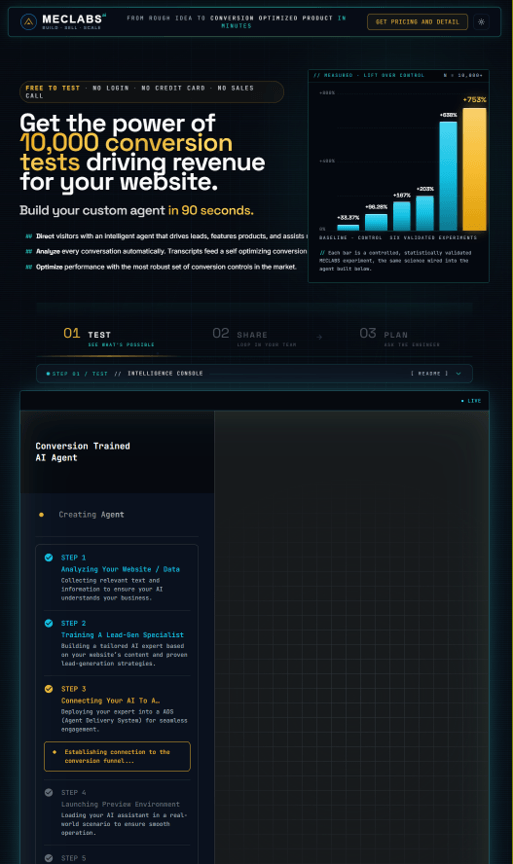
Once the automated builder creates their custom AI agent, they get more options. They can share the custom app with their team. Or they can talk with the MECLABS Installation Engineer AI agent and ask questions like:
Now that you’ve got a prospect to take a first step and build a relationship with you, map out what they need to know and do along the journey from that first action to final purchase.
If you introduce technical details too soon, you’re forcing the prospect to do homework before they understand the value. But if you wait too long, they may feel like your offering is all fluff and no meat.
Don’t overlook the ‘guide’ part of this step. If you just throw the right technical information at them at the right time, it’s not enough. It’s just more work you’re making them do. Certainly some highly motivated and technically savvy prospects might wade through all of the information. But how can you make it easier for them.
As an analogy, think about ultra-processed foods. To be clear, I am well aware they have a health downside I am in no way trying to defend. But the reason they are so popular is they are so easy to consume. Try eating a bag of chips versus a bag of raw broccoli.
So how can you ‘process’ the complexity to make it easier to consume for your prospects, while keeping the healthy part (the important information)? This is our challenge as marketers. And hopefully the next example about an industrial automation and control systems product sparks an idea in you for your product or service.
BEFORE
The industrial controls division at a power management company relied on technical datasheets, spec sheets, and white papers to communicate about its programmable logic controllers (PLC).
AFTER
The team launched a six-episode game show called Oh My PLC! on YouTube. Three real employees answered actual questions buyers were asking around PLC basics, types, power sources, global regulatory standards, connectivity, and IoT capabilities. The episodes were about 10 minutes long with a winner for each episode.
The show’s content was focused on helping the audience, and the company’s product was only mentioned as the show’s sponsor with ‘brought to you by’ framing at the beginning and end of each episode.
“The moment the show felt like an ad, we would lose the audience. Industrial buyers are sophisticated. They can smell a pitch immediately. We chose not to give them one,” explained Jen Manswell, founder & CEO, Mieileen Consulting (who formerly lead marketing communications for the industrial controls division).
After the first three episodes of the fun game show, the team hosted an Ask the Experts live digital event on YouTube and LinkedIn Live in which the engineers answered direct audience questions. They hosted the event again after the second half of the game show’s run as well.
“There was no sales presentation,” she said. “The explicit message to registrants was that they would be talking to the people who actually build and understand the product, not a sales team.”
RESULTS
Three-quarters of the prospects attracted by the program were net new to the industrial manufacturing brand – contacts not previously in the company's CRM who engaged with the company for the first time.
Complex products and services tend to feel abstract. One reason is the amount of buzzwords that are often used to communicate what they do. Marketing teams often use those buzzwords because it’s the best way they’ve figured out to communicate the complex, sometimes behind-the-scenes or underneath-the-hood value creation.
So when you’re guiding the customer through a journey, think of ways you can make the abstract feel real and tangible and not just rely on buzzwords. A few ideas:
Digital communication is core to marketing today, of course. But when it comes to making the abstract feel real, don’t overlook old school tactics like experiential, event, or direct mail that can literally give people a chance to touch and feel your product, like in our next example.
BEFORE
Vaisala makes climate measurement instruments, like dropsondes – torpedo-shaped devices hurricane hunters drop into storms to gather tracking data.
When Hurricane Irma hit, its PR team pitched media outlets and got some coverage, but not much. The team had only started working with the brand a few weeks before, and the storm was already tracking towards land when they started pitching.
AFTER
At the start of the next hurricane season (early June), the team mailed 20 physical dropsonde units – along with a custom infographic explaining the anatomy and function of a dropsonde and B-roll footage of the NOAA Hurricane Hunters – to national media and TV meteorologists.
“We played up the fact that this was an unusual package. We encouraged them to let their mailrooms know that this was coming and it was expected and not something dangerous. That caused them to be on the lookout,” said Doyle Albee, co-founder and managing partner, Prolexity (whose firm at the time handled PR for Vaisala).
When hurricanes started forming in late August and September, they re-engaged each outlet with a short pitch – ‘A storm is forming. You have a dropsonde on your shelf. Here's the expert's number [Vaisala’s chief science officer].’
The prop gave journalists something to hold on camera while explaining tropical forecasting during non-stop coverage. For print and digital journalists, the team leaned harder on the infographic and data angle.
RESULTS
The team got coverage from ABC News, Forbes, NBC News, The Wall Street Journal, Popular Science, and The Weather Channel.
“The best part: NBC's Al Roker used the physical dropsonde on-air during Tropical Storm Gordon coverage on NBC Nightly News. The prop was the story,” Albee said.
One reason entrepreneurs and marketers lean into the complex is because they want to sound credible. They think using industry jargon and SAT words makes them seem more like experts.
So if you simplify your message to make it easier to understand and more compelling to the prospect, it helps if you have the authority to back it up. After all, a prospect is not just evaluating a message itself, but the source of the message as well.
Take appliance repair as an example. If a prospect views a company as an expert, they are much more likely to be open to a simple explanation of what needs to be fixed and why it needs to be fixed…and invite the company in their home to begin with.
“If you search for Dennis Godynuk and his appliance repair company [Comfort Appliance Repair], Google AI Overviews shows he's an appliance technician and an appliance expert in the Nashville area,” said Kumar Vaibhav Tanwar, founder and digital marketing lead, Clickworthy Inc (Comfort Appliance Repair’s digital PR agency).
“To get him cited, my team looks for PR opportunities on Qwoted and other similar platforms,” Tanwar said. “Since last year, he and his website have been cited in sites like The Spruce, Family Handyman, Homes & Gardens, Real Simple, and Martha Stewart Living among others.”
You should coach your subject matter experts (SMEs) with some media training before arranging those press opportunities. Help them explain customer challenges and opportunities, the industry itself, and your product or service in simple terms to a reporter. Then, they can ask the reporter if their explanation is clear, and if the reporter would like to hear more about the complex technical information underpinning it.
Here’s a great quote you can use to inspire your SMEs. In his book 'The Marketer as Philosopher,' MECLABS AI CEO Flint McGlaughlin quotes Frédéric Chopin, "Simplicity is the final achievement. After one has played a vast quantity of notes and more notes, it is simplicity that emerges as the crowning reward of art."
As Chopin put it, simplicity is the final achievement because it signals mastery. As you work with your SMEs, encourage them that as true masters in their industry, they are the ones to simplify this complex information for the press and ultimately the greater public.
This article was distributed through the free MarketingSherpa email newsletter.
Become a Marketer-Philosopher: Create and optimize high-converting webpages (free digital marketing course)
From Engagement to Conversion: A deep dive into effective marketing strategies
This is a human-conceived and -written article, assisted by AI. MECLABS AI was used to review source pitches for artificial intelligence usage, craft follow up questions to sources, brainstorm the steps of this article, and make copy edit suggestions for the article. AI was also used to help generate supportive images for the article (like homepage thumbnail and social media Open Graph images), but not for creative samples in the article.
Get Better Business Results With a Skillfully Applied Customer-first Marketing Strategy

The customer-first approach of MarketingSherpa’s agency services can help you build the most effective strategy to serve customers and improve results, and then implement it across every customer touchpoint.
Get More Info >MECLABS AI

Get headlines, value prop, competitive analysis, and more.
Use the AI for FREE (for now) >Marketer Vs Machine

Marketer Vs Machine: We need to train the marketer to train the machine.
Watch Now >Live, Interactive Event

Join Flint McGlaughlin for Design Your Offer on May 22nd at 1 pm ET. You’ll learn proven strategies that drive real business results.
Get Your Scholarship >Free Marketing Course

Become a Marketer-Philosopher: Create and optimize high-converting webpages (with this free online marketing course)
See Course >Project and Ideas Pitch Template

A free template to help you win approval for your proposed projects and campaigns
Get the Template >Six Quick CTA checklists

These CTA checklists are specifically designed for your team — something practical to hold up against your CTAs to help the time-pressed marketer quickly consider the customer psychology of your “asks” and how you can improve them.
Get the Checklists >Infographic: How to Create a Model of Your Customer’s Mind
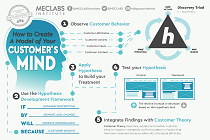
You need a repeatable methodology focused on building your organization’s customer wisdom throughout your campaigns and websites. This infographic can get you started.
Get the Infographic >Infographic: 21 Psychological Elements that Power Effective Web Design
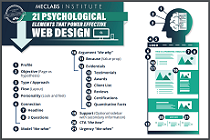
To build an effective page from scratch, you need to begin with the psychology of your customer. This infographic can get you started.
Get the Infographic >