|
SUMMARY:
Customers trust companies more when they are honest and clear about what they can and can’t do. Here are real-world examples to spark your best thinking for how your brand can use transparency to build trust. Pick one step from this MarketingSherpa article and implement it this week. Start with Step #7 if you want the fastest conversion lift. |
Action Box: Custom AI Agent Builder
Train a custom AI agent on your site's content in under 90 seconds. No cost or registration to try the AI Agent Builder (from MeclabsAI, MarketingSherpa’s parent company).
Transparency can be powerful because it rips away the four walls of your office or factory and shows prospects how you are creating value for them, value that may not be obvious from just glancing at a product on a shelf or hearing about a service.
Aside from accentuating the positive, transparency also clarifies the negative. After all, to run a profitable business, sometimes you will fall short of customers’ (sometimes unreasonable) expectations. What will they think when you do so? Let’s take a look at some data.
When we surveyed 2,400 consumers in the MarketingSherpa Customer Satisfaction Research Study, we saw a stark difference between satisfied and unsatisfied customers. Satisfied customers weren’t as focused on if a company was customer first (they ranked ‘it puts my needs and wants above its own business goals’ ninth out of nine options).
But for unsatisfied customers, ‘the company does not put my needs and wants above its own business goals’ was their top response.
Without transparency, the customer interprets a failure as intent. With transparency, the customer interprets the same failure as a constraint, tradeoff, or honest limitation. A reasonable customer is not reacting to the problem; they’re reacting to the meaning they attribute to why the problem happened.
By first getting your organization in a customer-first mindset, you can communicate a value proposition that properly sets up expectations for what customers will and won’t get (before a customer experience) as well as how customers are handled during the experience. And beyond marketing, if your organization becomes a truly customer-first business, the jump ball business decisions (those 50/50 decisions that could go either way) bounce in the direction of the customer.
All of this is essential because, as mentioned, you can’t always make sure the customer experience is what customers want it to be. But at least when you fall short of their desires, you can show (transparently) that your organization is doing what it can to work for their interests with the best of intentions even though there are reasonable restrictions and contingencies. And that can lead to the customer having a better view of the customer experience and, thus, more trust in your brand.
Because transparency is not primarily about being good. It’s about being clear enough for the customer to understand and believe your brand. When their (expressed and unexpressed) questions about the experience go unanswered, customers fill in the gaps with their own assumptions – and those assumptions are rarely generous.
Here’s an example from the parent company of MarketingSherpa, MeclabsAI. When we simply couldn’t speed up a process anymore without sacrificing quality, we showed prospects why they were waiting.
MeclabsAI has an automated system to create a custom AI agent. Companies can put on the custom AI agent on their landing pages to generate leads or sales, or hook it up to their phone system to answer calls. All a marketer or entrepreneur has to do is put in their company’s URL and click the ‘Create Agent’ button and MeclabsAI will make the custom agent that the user can then customize or edit.
The team launched an AI agent builder landing page where visitors can train an agent on a website’s content. The landing page reduces friction and anxiety by not requiring visitors to pay or even register to get started.
However, there is still length-oriented friction in the amount of time it takes to build the custom agent. The landing page says users can ‘build your custom agent in 90 seconds.’ When I’ve used it, it was actually closer to 65 or 70 seconds.
But people are impatient. That can feel like a long time.
In this case, the customer experience itself can’t be changed – while MeclabsAI is building the custom agent with machine speed, it still needs to perform several tasks to make a quality agent. So we provided transparency into the experience to help improve the visitor’s perception of the wait time – namely, showing that work is being done on their behalf.
Creative Sample #1: MeclabsAI landing page transparently showing work being done for the visitor
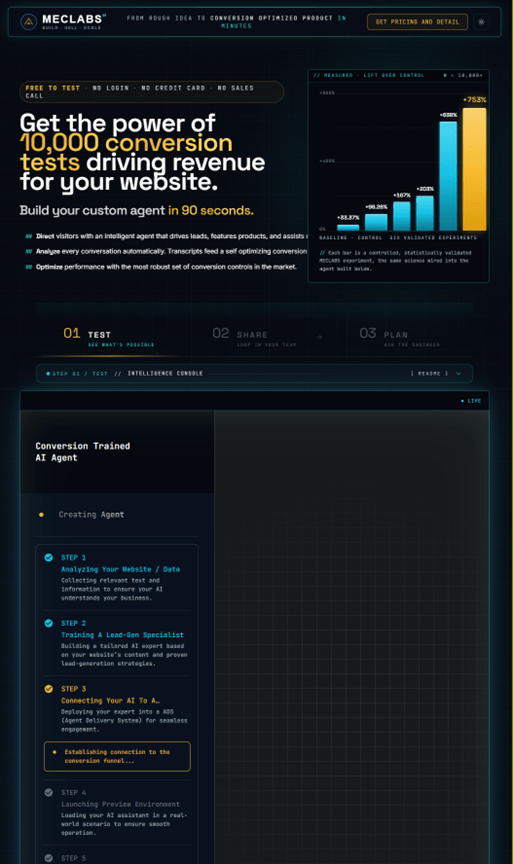
The page shows five steps the automated agent builder is doing for the visitor. For example, ‘STEP 1 Analyzing Your Website / Data. Collecting relevant text and information to ensure your AI understands your business.’
While the automated AI tool is working on that step, there is a revolving graphic and the message ‘Analyzing website data for insights.’ Once the steps is complete, it turns from yellow to blue, and the builder moves on to the next step.
And so it goes for each step, until the visitor sees ‘Your AI Agent is ready’ and the agent appears on screen to play with.
This is transparency as progress visibility – it doesn’t reduce wait time, it reduces uncertainty.
TAM can be poison to value propositions.
TAM stands for total addressable market, and every company looking for investors thinks they want a big TAM because there is more revenue potential.
But the reality is that your product is not the best solution for everyone. And if you try to serve everyone, you go to market with a weak value prop that doesn’t really serve anyone well.
So tightly define who your brand’s products and services can best serve, but also who they can’t. And use that messaging in your marketing. That transparency will help you avoid bringing on customers who have an underwhelming experience and can hurt your brand with negative reviews or word-of-mouth.
And when your ideal customer sees who it’s not for, it really hits them harder that your product could be just for them, what they’ve been looking for all along. It could be…
Or…
This can happen naturally in a conversation. Here’s an example from an entrepreneur who gets business for his AI-native AEO agency from conversations at business conferences.
“I tell people that AI answer engines like ChatGPT and Perplexity pull from sources they already trust, and if your brand has weak entity authority or thin third-party coverage, you simply won't appear. What I can do is build the conditions that make a brand citable. What I can't do is guarantee a specific mention in a specific answer. Anyone promising that doesn't understand how generative AI works,” said Tom Parling, founder, growthvibe.
That ‘customer fit’ transparency should happen through your digital channels as well. Here’s a real-world example from an app.
True for Two is a dating platform focused on long-term relationships and intentional dating. Of course, that’s not what everyone is looking for in a dating app.
The app’s onboarding experience has a breaking screen to filter out prospects who aren’t the right fit (a breaking screen is a step in an onboarding flow that intentionally interrupts the normal flow of onboarding to make the user pause, reflect, and commit before continuing).
The breaking screen explains that the platform is specifically designed for people seeking long-term relationships and marriage and that users looking for casual dating are not welcomed. It also lets users know that they will remove anyone who isn’t the right fit.
Creative Sample #2: Breaking screen after ‘What kind of relationship are you looking for?’ question in dating app’s onboarding flow

They ban ~10% of new users based on reports from other users, automatic triggers (which they can’t disclose publicly or users could game the system), or if a user publicly states in their ‘about me’ section that they are using the app for a reason that doesn’t align with its goals (for example, only using the app for sex).
In terms of product design, the team limited the number of profiles users see per day. They were worried it would hurt engagement metrics. But after implementing this approach, the team received qualitative feedback from users saying the experience felt less overwhelming (than the typical swipe-style dating app) and more aligned with what they were actually looking for.
“Transparency works best when it’s operational, not performative. In our case, it meant designing both the product and the messaging around clarity, even when that potentially reduced top-of-funnel volume,” said Natalia Sergeeva, chief product officer, True for Two.
Transparency can build trust…when orchestrated well.
But if you throw all that transparency at the customer at once, it can just be overwhelming.
Think of it in terms of your human relationships. Ever meet an oversharer? They tell you deeply intimate details of their life when you first meet, before you’re ready to take that kind of info in.
The same is true in a prospect-brand relationship. If you dump all the contract terms in the awareness phase of the customer journey, their first impression of your brand won’t be trust. It will just be overwhelmed.
So now that your team is in a customer-first mindset from Step #1, map out the customer journey. What does the customer need to know to make the best decision? And when do they need to know it?
Here’s an example of some transparency you can share at key stages:
Here’s an example.
BEFORE
Since The Monterey Company custom-manufacturers products, it needs some info from customers before they purchase.
To get this info, the team originally pushed website visitors into a quote form. A buyer would land on the custom patches page, read through several material and option explanations, then usually submit a form for help.
AFTER
“Instead of explaining every option at once, we focused the page on one decision at a time,” said Eric Turney, owner, sales and marketing director, The Monterey Company.
The new structure is built around one main choice first. The buyer chooses the patch type, then moves into the order path with artwork upload and basic options.
They tried to reduce the amount of option overload early in the page, since backing, size, thread detail, and production questions make more sense after the customer has chosen the patch type.
The proofing promise is much clearer now, too. The page makes it clear that production does not start right after checkout. The customer uploads the design, places the order, and the team sends a digital proof for approval before production begins.
“The change reduced basic clarification emails around how to start an order and helped route buyers better. The experienced buyers could begin online, while people with more questions still had an easy way to contact the team,” Turney said.
You could look at transparency as many things. A moral imperative perhaps. Or a philosophy on life.
But it is also squarely a business tactic. And like any other business tactic, sometimes its best use is to zig when everyone else is zagging. In other words, find a gap where customers are being underserved.
What are the least transparent areas in your industry? By being more transparent than the competition in these areas, you can add exclusivity to your value proposition. Here’s an example.
Homebuyers have access to a lot of information about a property they might buy through appraisals and inspections.
However, info on deaths, crimes, and other similar events was hard to come by. Some high-profile homes where a murder or suicide occurred have even had their addresses changed, usually to reduce stigma or public attention.
While there were general property-history services and real-estate due diligence tools, a two-person team created a highly specialized niche product built around transparency called DiedInHouse.
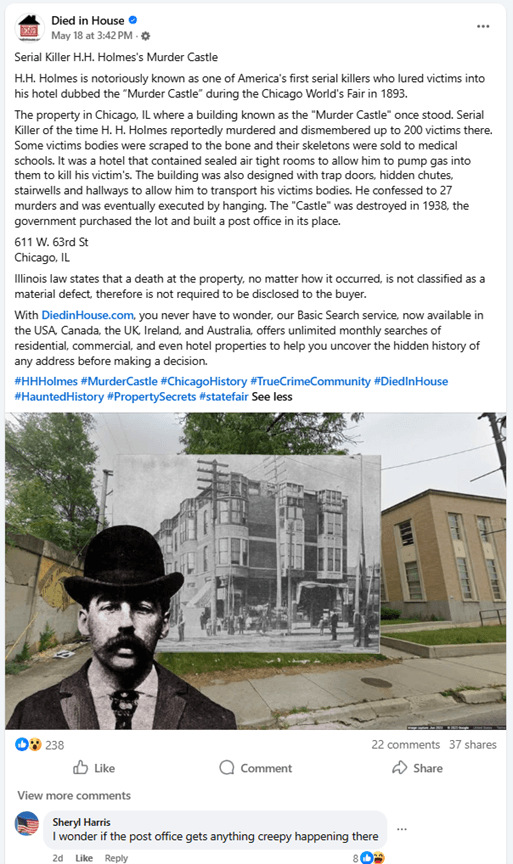
The company has been in business for 13 years. Since the team built a product around transparency, they have been able to use transparency to sell the product as well. “We don’t run ads. Instead, we use social media to share real stories about stigmatized homes,” said Roy Condrey, founder and CEO, DiedInHouse.com.
Creative Sample #3: Facebook post for niche property-history service
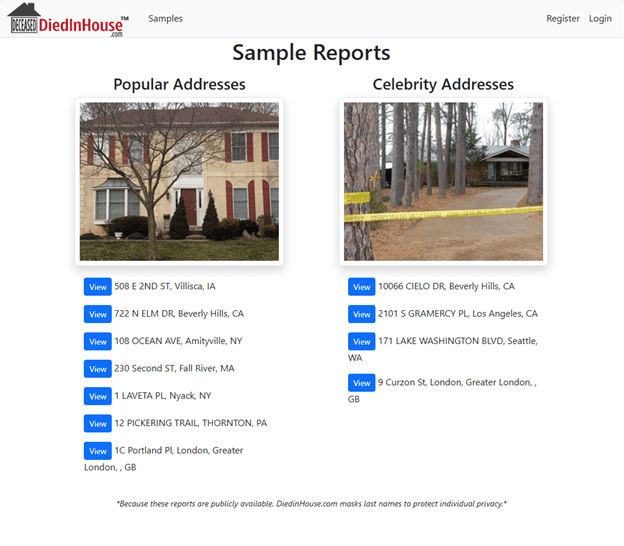
The website features a section with sample reports so potential buyers see what type of information they will receive if they buy a report.
Creative Sample #4: Samples section on niche property-history service website
This comes from the classic writer’s maxim. As Anton Chekhov famously said, “Don't tell me the moon is shining; show me the glint of light on broken glass.”
Chekhov hints at one reason this tactic works – it’s far more compelling to see or experience something than to just hear about it.
But from a marketing perspective, something else really important is going on. When you brag about how wonderful your product is, the skeptical prospect resists. But when they can come to their own understanding of the value they might experience, they are much more likely to get bought in. As our CEO Flint McGlaughlin has said in The Prospect’s Perception Gap, “Stop making claims of value and start fostering conclusions of value.”
This is easiest for a digital product. You can offer a free trial or a fully free version. Physical products have sampling or test drives. And for services products, there is the case study.
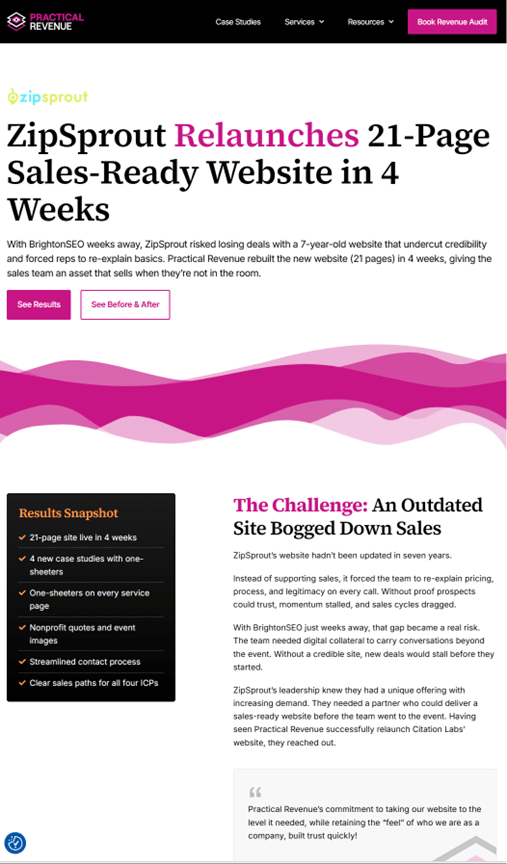
“Truth is in the details,” said James De Roche, founder, Practical Revenue.
To craft case studies, the team conducts interviews with one or two senior people who had a high-level view of the engagement – like project managers, delivery leads, and head sellers.
They use these interviews to build detailed 1,000- to 1,300-word case studies with a summary at the top and four to five detailed results. The body of the case study includes:
“Buyers and AI tools need granularity. The more transparent you are by providing relevant details, the more your buyers will trust your expertise,” he said. And that granularity helps the case studies get cited by LLMs, because large language models look for specifics and are more likely cite them.
The team also makes sure that the customer is the hero, positioning the company as a guide for their client. “You don’t want it to sound like the client was dumb,” De Roche said.
Creative Sample #5: Case study example
When you have to tell the customer something, use transparent language. Choose words they will easily understand.
This is especially important in complex fields that speak to a non-expert audience – for example, health care for consumers, or IT communicating to business professionals.
One way I’ve found in my career to get the right language is to look at the words customers use when writing or talking about your industry or product. You can often find this in reviews, industry forums, or on social media. Or just try to speak or write to a few customers and ask them about a topic without priming them (i.e., don’t use any specific wording just ask a question around the topic and see how they reply). Here’s a real-world example.
Dean Chew has more than 20 years of experience in digital marketing, which helped him identify a gap in the marketplace. Alcohol-tracking apps tended to use clinical language, so he decided to launch an app a few weeks ago with more transparent language. “Same instinct Apple applies when they say ‘Find My iPhone’ rather than ‘Mobile Device Recovery Service,’” said Dean Chew, founder, AlcoLog.
Here’s a look at the typical language used, and what Chew chose instead.
BEFORE and AFTER
Creative Sample #6: Goal picking stage in digital tracker app onboarding showing the five-goal choice architecture
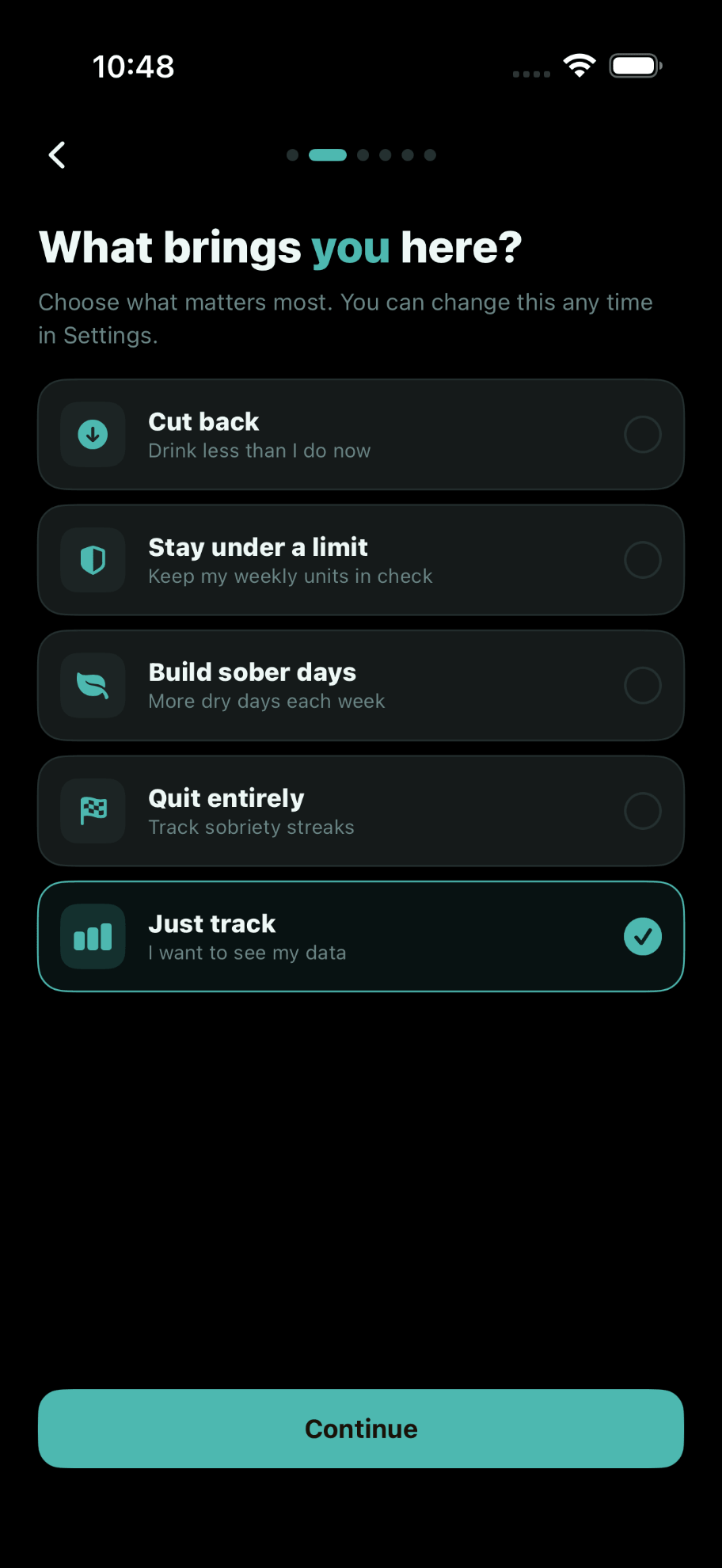
“The choice architecture deliberately includes a ‘do nothing’ option [‘Just track’], which is unusual for the category,” he said.
Creative Sample #7: Next screen after goal choice in app onboarding for ‘Just track’ option
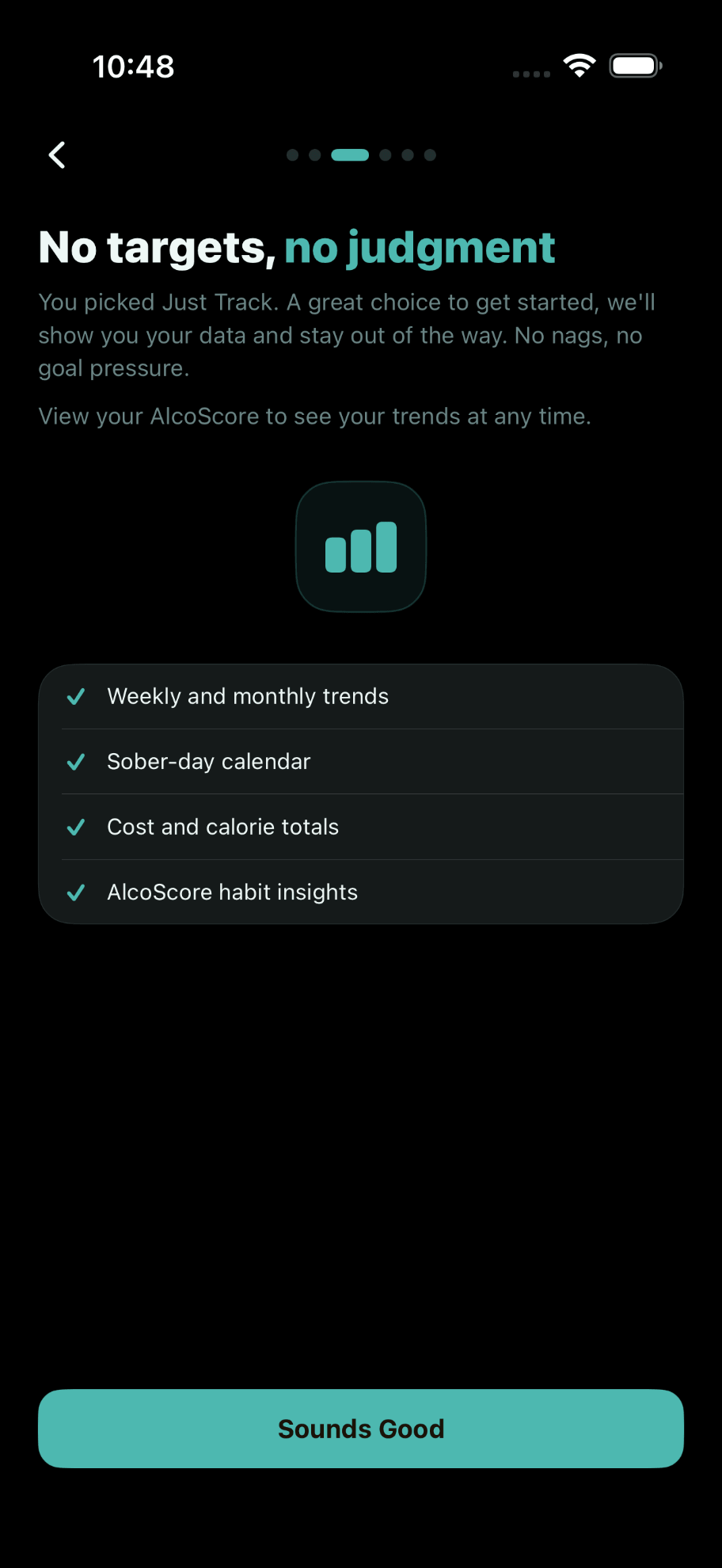
In this example, the language is used on an app. So in case you’re wondering how changing from clinical/technical to more transparent wording would affect a sensitive-category iOS app, Chew shared his experience.
His app was rejected by Apple four times in five days before being approved on day seven. However, none of the four rejections pushed back on language or framing. The rejections were all procedural.
“Four independent reviewers, operating under guidelines that include 1.4.1 (medical claims) and 5.1.1 (privacy), all looked at the health-adjacent and clinical-adjacent surfaces of the app and chose not to flag them. The proactive consumer-language work (the in-app disclaimers, the careful naming choices, the conservative framing in the App Description) was thoughtful enough upfront that Apple did not have to push back on it,” Chew said.
Let’s say you’ve really done a good job up to this point, and your ideal prospect is excited to take the next step. If they trust you to move forward, what happens then?
A call-to-action involves a leap of faith for a customer. Whether it’s something as simple as clicking a button, or more complex and riskier, like making a purchase – they are taking a chance on your brand.
You can reduce that anxiety (and thus, improve conversion) by transparently revealing what will happen if they take an action.
Explain what happens after someone converts: onboarding steps, timeline, milestones, communication cadence, what the customer must provide, and what you do.
Pricing is especially fraught. They may have had experiences before where they thought they knew the price, only to be hit by add-ons, implementation fees, shipping, taxes, automatic renewals, or tiered pricing. So transparently let them know what it will cost, and what’s involved in that pricing calculation.
Here is a B2C example, followed by a B2B example focused on AI decision transparency, and another B2B example focused on pricing.
Gentlemen Plumbing has extensive pricing information on its website – not specific prices like you would see on an ecommerce site (other than the $50 service visit fee) but details about what goes into a price and how the prospect can get a detailed quote.
Creative Sample #8: Plumber’s service visit fee webpage, with explanation
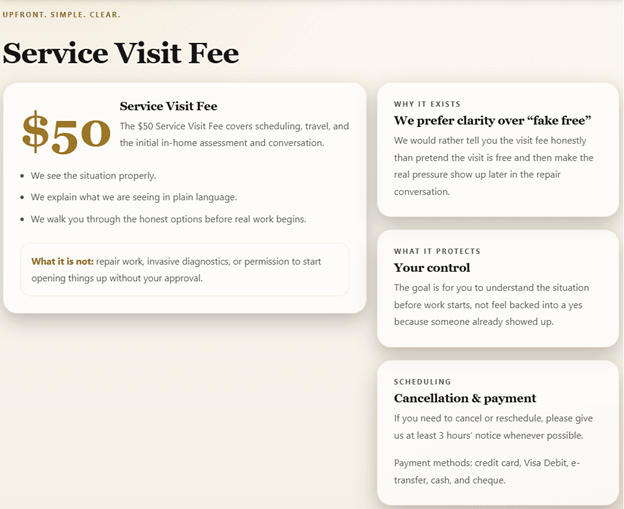
The home services company offers to provide pricing by phone, and explains which services are more and less likely to get accurate prices by phone, along with what aspects may affect the price.
Creative Sample #9: Pricing by phone explanation on plumber’s webpage
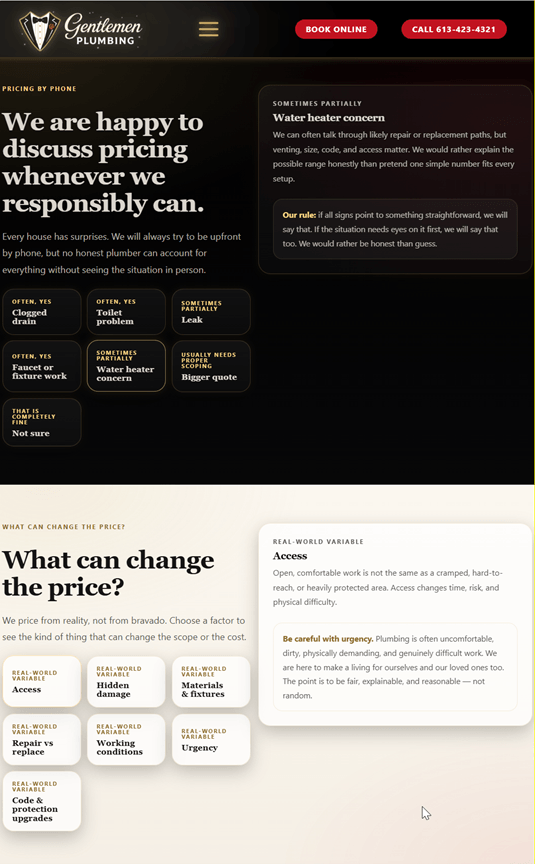
“My customers can FaceTime me and show me their issues and I'll tell them what I'm going to charge (assuming there's no surprises),” said Jake Romano, plumber and co-owner, Gentlemen Plumbing & Drain Cleaning. Here is the talk track he uses when he gets a call asking about service:
‘There are almost always options. When I see the house, I’ll discuss the options that I think you should consider and how much they’ll cost. But if it’s what it seems to be, then it’s going to be $XXX. That being said, I’m not able to see the work or run any tests, I’m going based off what I’m hearing… If there are surprises and I can’t solve the problem for the price I said, I’ll discuss everything before we proceed. I’m doing the best I can with the information available.’
RESULTS
Previous plumbing companies he’s worked at would not give the prospect any indication of the price beforehand, charge a high service fee to come out, and then roll the service fee into the price of the service if customers chose to go with them when they discovered the actual price (which would only happen in person, sometimes in a high-pressure situation).
From his previous experience, he estimates:
Romano contrasts that with his current business and pricing approach. While the business is admittedly new, he has only missed out on one opportunity so far.
“But more importantly, I have five stars out of five on Google. I’m a newer company, but I have 25 reviews and they’re all perfect,” Romano said.
Part of his transparent pricing strategy goes beyond current results though. He’s focused on the bigger picture of long-term sustainability for his business.
“I’m not here to get your $500 today. The average homeowner will spend $5,000-$20,000 on plumbing over the course of their life. If I create strong relationships through good practices and honesty, then I’ll get the $5,000-$20,000,” he told me. “But even if it weren’t for that thought, I honestly struggled with business practices I didn’t agree with.”
Shiplo uses artificial intelligence to help companies optimize their shipping. “Heale and Optym support the AI, optimization, and technical intelligence side of the platform,” explained Daniel Cunningham, Jr., founder & CEO, Shiplo.
Instead of running shipping decisions through several disconnected systems, the platform brings those pieces into one coordinated logistics layer. So in this example, the next step for the customer is choosing a shipping option. “That is where AI transparency becomes practical for us. We do not think the useful disclosure is simply ‘AI was used.’ The useful disclosure is explaining the decision path,” he said.
Shiplo reduces that leap-of-faith by showing the customer (and internal team) why a specific option was chosen the moment they are asked to approve it. Here are some examples of how the platform explains the decision path:
“The goal is not to hide automation behind a black box. The goal is to make each shipping decision easier to understand, review, and improve,” Cunningham concluded.
BEFORE
The video studio had a standard ‘request a quote’ flow which led to a 20- to 30-minute discovery call followed by a custom proposal.
AFTER
After posting transparent pricing publicly, leads arrive pre-qualified. “The people who fill out the contact form already know what they're buying and have mentally approved the budget,” said Sebastian Buckeridge, founder & CEO, Studio Monday.
RESULTS
Buckeridge couldn’t provide a clean CRM export, but he was transparent about that limitation. “What I have is a clear before-and-after in my memory of how sales conversations felt and how often they converted, plus the fact that I stopped spending time on proposals that went nowhere after the pricing went live,” he said.
Buckeridge estimates that close rate went from around 20 percent to closer to 60 percent over 18 months.
As marketers and entrepreneurs, we often focus all our communication energy externally on the customer.
But we forget, those marketing skills can help internally as well. After all, a company is just a group of humans working on a task together. Here’s an example.
BEFORE
Lead form data went to a Gmail inbox. There was no clear reporting within the home remodeling company to see when a lead arrived, who picked it up, or how long it sat untouched.
“The failure point was an invisible delay. The business owner assumed leads were being called quickly. They weren't. I identified it by asking a simple question: ‘Can you show me the timestamp of when each lead came in and when the first call was made?’", said Ihor Poliukhovych, Revenue Automation Engineer, 2044 Media.
AFTER
Every new lead triggered a Telegram bot alert to the call center channel, giving the client's name, phone, email, and a timestamp.,” Poliukhovych explained.
The operator had to reply ‘OK’ when they called to follow up on the lead dialed. This made response time visible to the whole team in real time, including management.
Creative Sample #10: Internal Telegram message with five-minute lead follow-up alert
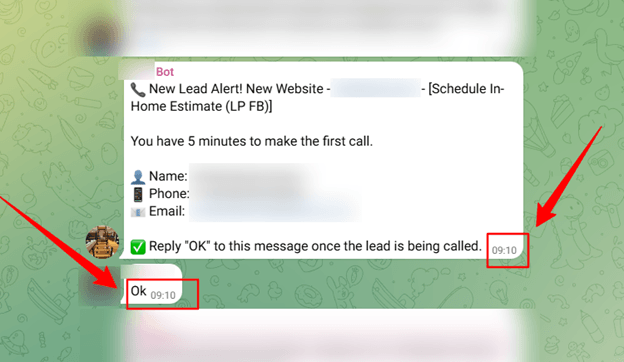
“We made the lead handling process fully visible and accountable,” Poliukhovych explained. “Instant lead routing via Make.com to GoHighLevel to Pipedrive. Immediate SMS response [to prospect] via Twilio. Telegram bot with a 5-minute confirmation rule for callbacks.”
RESULTS
Ad spend stayed flat during the transition period at roughly $13,000 for 224 leads (~$58/lead CPL). But more leads turned into booked appointments, and more appointments turned into signed contracts. The improved downstream performance increased revenue from #$300,000 to more than $1 million over 12 months.
“Most SMBs don’t have a lead generation problem – they have a transparency problem in how leads are handled,” he concluded.
It’s one thing to provide transparency on the value your products and services provide. It’s a little harder to provide transparency when you’re not the best solution for a customer.
When things go wrong, it can be even harder to make the case for transparency internally. Who wants to admit mistakes?
But as our customer-first marketing research mentioned in the first step in this article found, it’s not just the outcome that matters, many customers consider a brand’s motivations as well. If customers feel like a brand is generally trying to act in their best interest, they will be more forgiving. The reverse is true as well.
Here’s some more recent research. In FTI Consulting’s March 2026 Retail Resiliency Survey of 967 U.S. adults weighted to U.S. Census benchmarks, 76% of consumers said how a company handled a recent controversy affected their decision to stop purchasing from the company.
“In today’s environment, where controversies and negative customer experiences spread instantly across social media, reviews, and AI-driven search, transparency can strongly shape whether consumers see a company as honest and accountable or feel like it’s avoiding the issue,” said Rachel Rosenblatt, head of Americas retail & consumer products sector, FTI Consulting.
She continued, “How a company communicates in those moments, how quickly it responds, how transparent and direct it is, and whether people feel it’s being genuine, increasingly influences whether consumers are willing to come back after trust has been shaken.”
This article was distributed through the free MarketingSherpa email newsletter.
Related Resources
Transparent Marketing: How to earn the trust of a skeptical consumer
Content Marketing: 9 examples of transparent marketing
AI transparency
This is a human-conceived and -written article, assisted by AI. MeclabsAI was used to review source pitches for artificial intelligence usage, craft follow up questions to sources, brainstorm the steps of this article, and make copy edit suggestions for the article.
Get Better Business Results With a Skillfully Applied Customer-first Marketing Strategy

The customer-first approach of MarketingSherpa’s agency services can help you build the most effective strategy to serve customers and improve results, and then implement it across every customer touchpoint.
Get More Info >MECLABS AI

Get headlines, value prop, competitive analysis, and more.
Use the AI for FREE (for now) >Marketer Vs Machine

Marketer Vs Machine: We need to train the marketer to train the machine.
Watch Now >Live, Interactive Event

Join Flint McGlaughlin for Design Your Offer on May 22nd at 1 pm ET. You’ll learn proven strategies that drive real business results.
Get Your Scholarship >Free Marketing Course

Become a Marketer-Philosopher: Create and optimize high-converting webpages (with this free online marketing course)
See Course >Project and Ideas Pitch Template

A free template to help you win approval for your proposed projects and campaigns
Get the Template >Six Quick CTA checklists

These CTA checklists are specifically designed for your team — something practical to hold up against your CTAs to help the time-pressed marketer quickly consider the customer psychology of your “asks” and how you can improve them.
Get the Checklists >Infographic: How to Create a Model of Your Customer’s Mind
You need a repeatable methodology focused on building your organization’s customer wisdom throughout your campaigns and websites. This infographic can get you started.
Get the Infographic >Infographic: 21 Psychological Elements that Power Effective Web Design

To build an effective page from scratch, you need to begin with the psychology of your customer. This infographic can get you started.
Get the Infographic >