|
SUMMARY:
What should companies do differently now that customers use AI to research before they buy? Be radically clearer to match AI-informed buyers’ ability to get highly tailored advice for their unique situation. And publish answers, pricing, and information to win the trust of human prospects and their AI agents as they quickly evaluate to see if your offer is a fit. Get ideas how to do it in this MarketingSherpa article. We share real-world examples for seven key shifts you need to make when buyers use AI before they contact you. |
Action Box: Transparent Marketing, Part 2: How to earn the trust of a skeptical machine
In the age of LLMs, this timeless principle is even more important to driving revenue. Join us for a free AI Guild session on Tuesday, October 13th at 2:00 pm EDT. Register now (from MECLABS AI, MarketingSherpa’s parent company).
It used to be nice when you knew someone in the industry, right? ‘I need to get some plumbing quotes, and my brother-in-law is a plumber, he lives out of town but at least I can get his advice on these quotes.’
Now, everyone knows someone in the industry. And that someone is artificial intelligence.
Sure, prospects did plenty of Googling back in the day. Asked other people on forums or social media. Watched YouTube videos. And read magazine reviews in Consumer Reports before the internet existed. So over time, prospects were already becoming more knowledgeable before that first interaction with a brand.
But AI is an entirely different level because the advice your prospects get is so personalized. They can take a picture and ask how a plumber should handle the situation along with a fair cost. Or upload a bunch of insurance quotes in AI and get the exact emails they should use to reply to insurance agents.
This new consumer empowerment necessitates a communication shift with customers to provide more context for your recommendations. You must show buyers exactly how you have defined their goal or problem, what you recommend based on it, and why you are making that recommendation. Here’s an example.
BEFORE
The team would focus on communicating the problem and then their recommendations to fix the problem.
AFTER
The team noticed a shift in its ideal customer. “I can tell from the conversations with the building owners about the inspection and repairs. They come more prepared and specific regarding the conditions, repairs needed, and recommendations,” said Cameron Figgins, owner and president, Absolute Maintenance & Consulting.
So now they go into greater detail about the problems they have discovered, showing pictures and moisture data from the inspection. And they also provide more detailed reasons behind their recommendations to help the client understand the scope of the work needed to restore their structure.
RESULTS
Since prospects come in better informed from AI to begin with, and get greater detail from the team, they now make the decision to have the work done quicker than they used to. They also have less hesitation and discussion about the cost since they understand the issues.
There was a time when brands entirely controlled the pricing conversation for the complex sale. And a single rule prevailed – present value before presenting cost.
But times slowly changed as the internet grew and forced the complex sale to move from a dictatorship to a democracy.
“One of our first blog articles was ‘How Much Does a Fiberglass Pool Cost?’” Marcus Sheridan wrote in Is Your Company Embracing ‘Fear-Based’ or ‘Fear-Less’ Marketing in 2012 and Beyond?
He continued, “Because everyone else in the swimming pool industry (we’re talking about thousands of companies here) had not addressed this simple question on their website (again, due to fear), the article immediately ranked number one on Google for the phrase ‘Fiberglass Pool Cost.’”
Sheridan wrote that MarketingSherpa blog post 15 years ago. And since then, AI has only supercharged the democratization of information because it can do a better job than traditional search of bypassing the hype and focusing on specific information.
Making pricing criteria explicit and available in a format that is easily quotable by AI gives artificial intelligence engines the clarity and verification they need to answer user prompts. Here’s an example.
BEFORE
The employee advocacy platform’s customers are B2B organizations, mostly SaaS, professional services and consulting, weighted toward mid-market rather than enterprise. Average annual contract value is $5,991.
Paid advertising played a key role in the company’s marketing strategy.
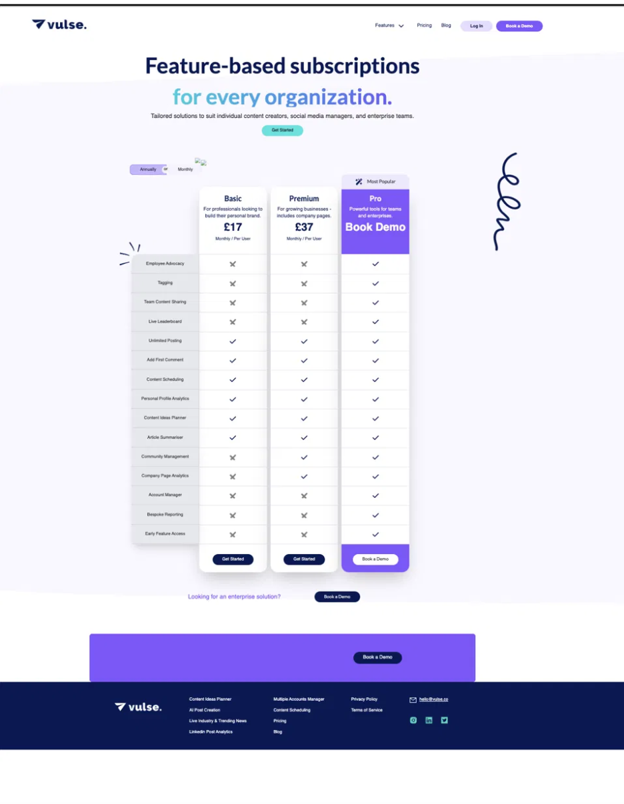
The pricing page had three tiers, with a specific price for each of the lower two tiers, but a ‘book demo’ subhead for the highest tier. The headline read, ‘Feature-based subscriptions for every organization.’
Creative Sample #1: Employee advocacy software’s old pricing page
The team asks inbound leads how they heard about the company as the last question in its calls – ‘with our marketing hat on, please can you tell us exactly how you found us, as it helps us to improve how often we're discovered?’
Across 96 demos from the previous six months, 30% had discovered the company through artificial intelligence. “They often narrow down their searches to a specific shortlist, for example, ‘employee advocacy platforms for LinkedIn, for a team of 20 with affordable pricing,’” said Rob Illidge, CEO, Vulse.
AFTER
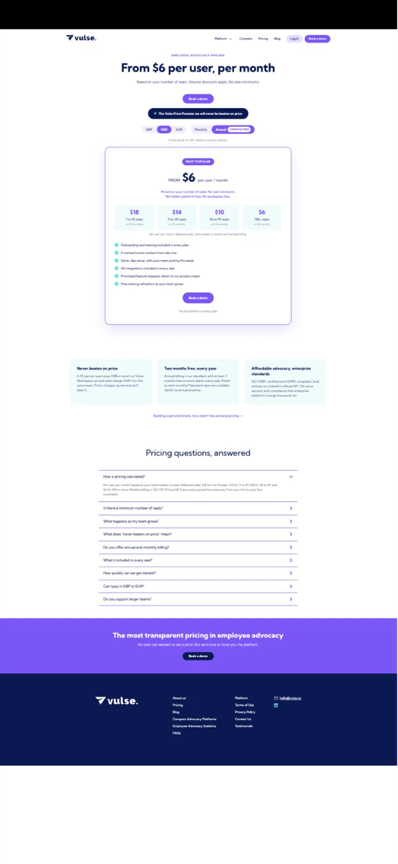
When they realized the prominent role pricing played in AI recommendations, they added prices to directory listings and redesigned the pricing page.
The new pricing page headline read ‘From $6 per user, per month’ with an ‘EMPLOYEE ADVOCACY PRICING’ eyebrow above the headline. And the page had a pricing table that broke down per user costs based on the number of seats.
They added an FAQ at the bottom of the page, with the first answer restating the entire pricing logic in prose in addition to the visual table on the page that is harder to parse for AI.
Creative Sample #2: Employee advocacy software’s new pricing page
They also took money away from paid advertising and focused on giving LLMs more clarity. “Google Ads and Bing Ads both stopped at around $4,000 per month,” he said. The budget reallocation went to:
“G2 reviews roughly doubled, listicle placements landed, and directory listings gained pricing where previously they had none,” Illidge explained.
RESULTS
Demos increased from 96 to 216 demos over the last six months. And triple the people on those calls said they discovered the company through an LLM. “Around 90% had asked ChatGPT or Perplexity [or another LLM] which employee advocacy tools to consider before they contacted us,” Illidge said. Here’s the inbound lead source breakdown:
For some of the shifts in this article, they didn’t come out of nowhere. It’s more mashing on the accelerator of where things were already headed than making a U-turn.
And this shift is a perfect example. An SEO in the early days might have used keyword stuffing to rank on a search engine (who else remembers a bunch of white-on-white keywords strewn across the bottom of webpages?).
But, search engines had increasingly been tweaking their algorithms to reward long-form, authoritative content.
That approach has greatly accelerated in the age of artificial intelligence. Prospective buyers are able to ask much more detailed questions than were previously allowed in small search boxes.
So content that simply covers a topic generally isn’t enough. I called this Book Report SEO content marketing, because this approach usually featured pushing out very generic overview content.
Now, you need to be like Comic Book Guy on “The Simpsons.” Really get in there and get funky with it.
You can’t just settle for your industry’s version of ‘Peter Parker is a student bitten by a radioactive spider who gets superpowers.’
You need relentless specificity. Unapologetic depth. A focus on an ideal customer. And even a viewpoint.
‘As a scholarship student grinding through a work-study night shift, you lack the cushy safety net enjoyed by your more embarrassingly privileged peers. You have zero margin for error. That’s Peter Parker: a Queens science kid already lugging around adult consequences before he’s even old enough to rent a car. Then a radioactive spider bite hands him the sort of strength and reflexes that lesser minds fantasize about…until he learns the obvious: power doesn’t reduce pressure, it compound-interests it. Now he has to keep his grades high enough to hang onto his Empire State University scholarship while playing unpaid guardian of a city that watches, records, and punishes mistakes with the enthusiasm of an internet comment section. Worst. “Upgrade.” Ever.’
That’s an off-the-wall example to get you thinking. In reality, in your industry you probably need to publish specific, helpful guidance…not the hyper-niche elitism paired with acerbic wit Comic Book Guy is known for. I only use Comic Book Guy as a very human (cartoon) example of this shift.
So don’t stop at ‘let me tell you about [industry]’ with your content. Go deep. Get to ‘if you find yourself in these types of situations, here’s what you should do next to [solve problem/meet goal].’
Don’t just think in terms of ideal outcomes. Go deeper. How do your ideal customers overcome the constraints that make it hard? What criteria matter most? What options and trade-offs will your ideal customer face? And what are the best next steps for them in this situation (which honestly may, or may not, be hiring your firm)?
Here’s an example of getting specific with content.
BEFORE
“Historically, a homeowner might Google ‘roofing company Austin,’ visit a few websites, read reviews, and call three companies,” said Nicholas Riley, owner, Driftwood Builders Roofing.
One to two years ago, the questions they would hear from prospects were broad, like:
Like many contractors, their website encouraged a homeowner to request an estimate. The site had a relatively limited library of educational content.
AFTER
Now they hear much more specific evaluation questions, like:
So the team built dozens of location pages, project pages, articles and videos answering very specific homeowner questions.
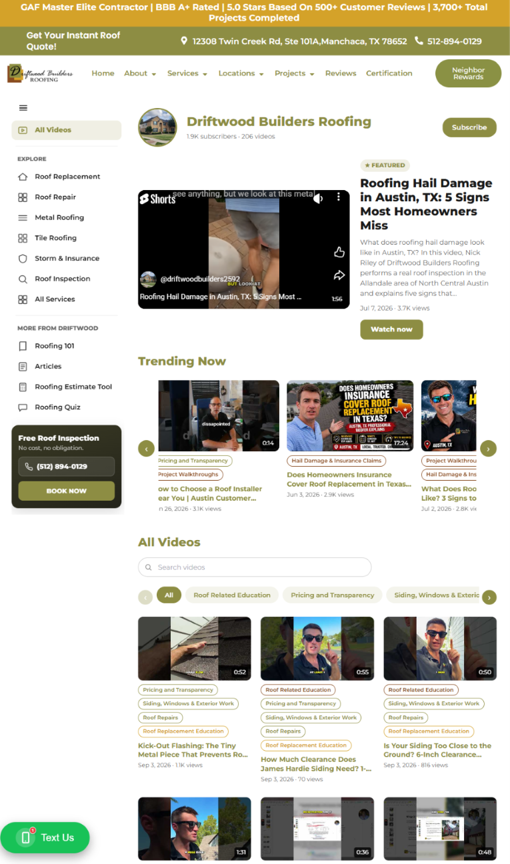
They created YouTube videos to answer these specific questions, like ‘GAF vs TAMKO Shingles: Which Is Better for Roof Replacement? | Austin Roofer Reveals the Truth.’ They published these videos in a searchable knowledge center on the roofing company’s website.
Creative Sample #3: Knowledge center on roofing service website
They also built in-depth pages to provide information on topics like:
Creative Sample #4: Top of very long pricing page for roofing contractor
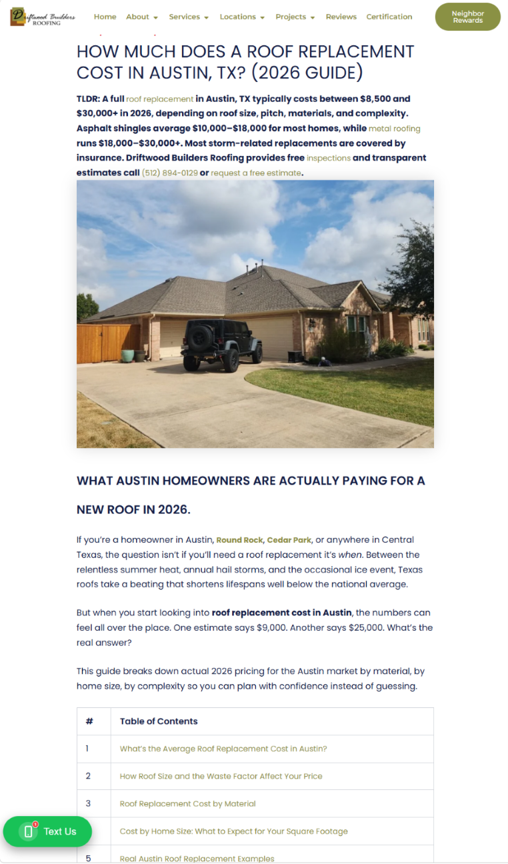
“The goal is not simply to rank for ‘roof replacement cost Austin.’ It is to answer the exact question a homeowner would otherwise take to ChatGPT,” Riley said.
In addition to their own content creation, the team worked to earn third-party media coverage.
“We have also become much more focused on third-party corroboration,” he said. “For example, Driftwood has now been quoted or featured in a growing number of national and local publications and media outlets. That matters because it gives both search engines and AI systems independent sources that verify who we are and what expertise we have.”
RESULTS
According to Google Search Console, average position improved from 49.6 to 18.4. The team can’t entirely attribute this increase to better answering prospect’s more complex questions, because they made other changes at the same time as well, like technical SEO and internal linking.
They’ve also noticed the sales conversations are much more advanced, which means they are getting more qualified leads. Instead of talking about a general topic like a standing seam, they talk about specifics like 24-gauge vs. 26-gauge, or Galvalume vs. painted metal.
As I’ve discussed in this article, your ideal prospects’ concerns are becoming more fragmented and more niche as they increasingly get custom advice from artificial intelligence interactions.
Which means, there is an increased need to understand the humans who are your customers at a deeper level than general campaign measurement.
You can call this journey intelligence. You could call it funnel analysis. Or you can simply think of it as having the very human curiosity and compassion to understand your fellow humans very real wants, needs, goals and fears…so you can better serve them.
The challenge is, you also have very real human blind spots.
AI-assisted pattern detection can ensure you don’t inadvertently overweight the proverbial loudest voice in the room, or highest paid person’s opinion. But auditing is key, since artificial intelligence can have its own blind spots and biases as well.
Here’s an example where employees are essentially internal buyers.
BEFORE
To plan for their AI adoption workshops, the team used a manual process of reviewing survey responses, emails, interviews, and workshop-planning notes.
With this approach, they tended to overweight very vivid responses, especially when coming from senior employees.
AFTER
“A memorable individual request can pull your attention toward a feature or use case. AI becomes more valuable when it shows you that several superficially different complaints are manifestations of the same underlying problem,” said Dr. Gleb Tsipursky, CEO, Disaster Avoidance Experts.
The team gives artificial intelligence de-identified responses and uses AI as a first-pass pattern detector.
They ask for the evidence behind each cluster to make sure the AI model isn’t grouping two complaints just because the responses use similar words although the underlying business problems were different. “For example, ‘reviewing documents’ can mean clerical extraction in one function and high-stakes professional judgment in another. I override clusters when the operational risk, expertise requirement, or decision authority differs materially,” he explained.
And then ultimately, a human makes the decision on how the AI analysis will inform the workshop.
Twas a time in the olden days when marketers couldn’t attribute every dollar they spent on marketing directly to a sale. As John Wanamaker famously said, "Half the money I spend on advertising is wasted; the trouble is I don't know which half."
Then modern attribution tracking came along. It was always a myth that we could truly attribute everything, but it sure felt like we could. For example, our MarketingSherpa research has shown that print advertising is the most-trusted advertising channel when customers want to make a purchase decision. So one could easily extrapolate that the trust signals generated by a newspaper or magazine ad gave a boost to digital PPC ads. But how many brands gave print that attribution?
We’re still in the early days of artificial intelligence’s effect on buyer evaluation. But it’s clear that AI doesn’t get all the attribution it deserves. For example, an AI chat can then lead a customer to search out a specific store, product, or professional service firm. Yet the analytics may show that as direct.
There are (at least) three ways to fine tune your attribution in the AI era. Firstly, customer intimacy. Get outside the platform and actually talk to or email them to better understand their journey.
Put a custom AI agent on your website and analyze those conversations for what they reveal about the buyer’s journey.
And, of course, constantly evaluate and re-evaluate the platforms you use for attribution, like in our next example.
BEFORE
Through 2025, the team relied on Google Analytics 4 referral data, filtering session sources for large language model’s domains, like chatgpt.com of perplexity.ai.
AFTER
“In February, Bing Webmaster Tools released its AI performance dashboard, which shows actual citations of your pages inside AI answers, so we finally saw the top of the funnel. And this summer Shopify rolled out the agentic storefront, which gives us attributed orders at the point of sale,” said Stefan Chiriacescu, founder & CEO, eCommerce Today Agency.
RESULTS
The agency manages marketing for 200 Shopify stores.
Last year, revenue coming from LLMs was under one percent. In the first half of this year, it reached eight percent.
That number comes with two caveats. “The eight percent figure comes from progressively better instruments, and if anything the early period was undercounted, not inflated,” Chiriacescu said.
Second, even with the updated tracking, the team realizes they still may not be capturing the full impact of AI on moving buyer evaluation upstream. “We think the real number is higher, because the LLM is usually just the first step. The purchase decision then runs over several days,” he said.
“The basis for your value, and the metric that you charge for it, are not necessarily the same,” Flint McGlaughlin, CEO, MECLABS AI, taught in The New Economics (And Philosophy) of Value in the AI Era.
Many industries traditionally derived revenue by charging for the effort they performed on behalf of a client using billable hours. The rate of those hours might change based on the seniority of the person working for the client, but the same general principle applied – we have to charge you this amount of money because we are physically taking the time to do work on your behalf.
But with the rise of AI, the perception of the value of work has changed. What would previously take hours or days can now happen near instantaneously. And a novice customer may not be able to tell the difference in value of the two outputs.
Or they may regard that the professional services output is better, but the AI output is good enough…especially when considering the huge price difference.
So you may need to shift how you charge your clients. Here’s an example.
BEFORE
Two years ago, buyers wanted to see the demo and asked questions like ‘What are your blended hourly rates across these roles?’
“We led the way everyone in the professional services industry led: headcount deployment plans, capacity modeling, timesheets, and rate cards,” explained Peter Grant, CEO and co-founder, Weaver.
AFTER
Today, prospects want to understand the long-term economics, and ask questions like ‘What are we actually getting back per dollar of AI compute spend, measured continuously?’
So now the team leads with outcome-based pricing models, transparent token-cost tracking, and governance frameworks. “We tie our price to the outcome rather than the effort,” Grant said.
What this looks like in practice is a fixed fee for a fixed scope on a fixed timeline with a return that was modeled before anything is built.
At MECLABS (MarketingSherpa’s parent company), we’ve always taught that exclusivity was a key component of an effective value proposition.
That exclusivity used to focus on your competitors. Previously I’ve written about the three types of competitors to keep an eye on. I originally wrote this blog post because I found that some brands were myopically focused on direct competitors and could overlook threats to their value prop.
Today, I think it makes sense to add a fourth competitor for many products and services that can come out of nowhere to eat your lunch – artificial intelligence. Whether you make software or sell services, many customers now perceive that they can do it themselves with AI.
When conducting competitive research, look for:
Types of competitors, updated for the year 2026
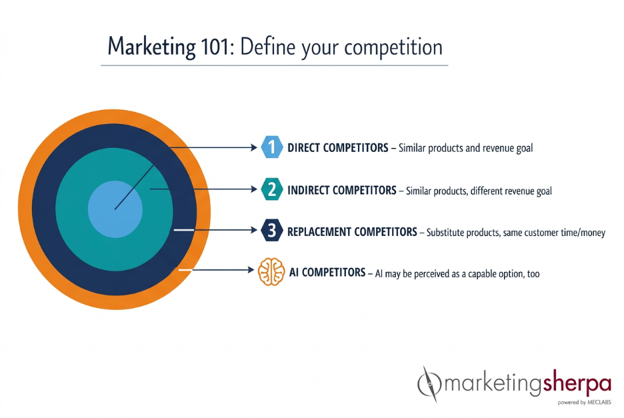
I’ll illustrate this with an example. Let’s say your brand is a premium streaming music platform. A direct competitor would be another streaming platform. An indirect competitor might be satellite radio. A replacement competitor might be vinyl records of compact discs (both are making a comeback). An AI competitor could be a platform that allows people to generate their own songs with prompts.
Here’s a real-world example of how these types of competitors can sneak up on you if you’re not careful.
“We had an 80-something share at the time, and we didn't want to lose a point or a 10th of a point of share to Powerade. And we measured it weekly. And it was just very, very, very focused,” Derek Detenber told me about his time at Gatorade, in World-Class Consumer & Retail Brands: What right do we have as a brand to be in that business? (Podcast Episode #15).
“We weren't losing share to Powerade, but our business was slowing down.” He continued, “And you look around and you have all of a sudden you have all of these smallish new brands that are out there, VitaminWater probably being the most prominent… they were stealing the occasions that, frankly, Gatorade and Powerade didn't really have the right to win.”
In this case, a replacement competitor – enhanced vitamin water – snuck up and took away sales from sports drinks.
AI could do the same thing to your business.
So when you craft your value prop, make sure it includes exclusivity against AI if AI is a potential competitor. For example, there is a lot of talk about artificial intelligence hurting SaaS sales because companies can easily build their own software. In this case, a SaaS brand may want to message the security its software offers versus homegrown, AI-built software.
In some cases where AI has an undeniable appeal (because of 24/7 access or lower cost) you may want to match those features and bring in exclusivity by leveraging your custom methodology, niche experience, and intellectual property to train your own, custom-built AI agent.
Your AI agent can meet them early in the funnel when they are using AI and bring them on a journey of conclusions that leads them to hire the humans in your professional services firm. Which ties into our final action box.
Action Box: Grow your client base with an intelligent intake agent
Enter your website URL and Easy Agent Builder will email you a custom, ready-to-embed intake/sales chat agent trained on your site. You’ll get $100 free credits to use it. No credit card required (from MECLABS AI, MarketingSherpa’s parent company).
This article was distributed through the free MarketingSherpa email newsletter.
Related resources
MarketingSherpa’s entity-and-evidence framework
AI transparency
This is a human-conceived and -written article, assisted by AI. MECLABS AI was used to review source pitches for artificial intelligence usage, evaluate the credibility of potential sources, craft follow-up questions to sources, brainstorm the steps and advice in this article, create Open Graph and CMS thumbnail images, and provide copy-edit suggestions for the article.
Get Better Business Results With a Skillfully Applied Customer-first Marketing Strategy

The customer-first approach of MarketingSherpa’s agency services can help you build the most effective strategy to serve customers and improve results, and then implement it across every customer touchpoint.
Get More Info >MECLABS AI

Get headlines, value prop, competitive analysis, and more.
Use the AI for FREE (for now) >Marketer Vs Machine

Marketer Vs Machine: We need to train the marketer to train the machine.
Watch Now >Live, Interactive Event

Join Flint McGlaughlin for Design Your Offer on May 22nd at 1 pm ET. You’ll learn proven strategies that drive real business results.
Get Your Scholarship >Free Marketing Course

Become a Marketer-Philosopher: Create and optimize high-converting webpages (with this free online marketing course)
See Course >Project and Ideas Pitch Template

A free template to help you win approval for your proposed projects and campaigns
Get the Template >Six Quick CTA checklists

These CTA checklists are specifically designed for your team — something practical to hold up against your CTAs to help the time-pressed marketer quickly consider the customer psychology of your “asks” and how you can improve them.
Get the Checklists >Infographic: How to Create a Model of Your Customer’s Mind
You need a repeatable methodology focused on building your organization’s customer wisdom throughout your campaigns and websites. This infographic can get you started.
Get the Infographic >Infographic: 21 Psychological Elements that Power Effective Web Design

To build an effective page from scratch, you need to begin with the psychology of your customer. This infographic can get you started.
Get the Infographic >