|
SUMMARY:
“How to be found on AI.” I was interviewing a member of the AI Guild about fresh ideas for the free community, and this was one of her top motivations for learning more about artificial intelligence. Large language models don’t recognize brands the way search engines rank pages – they reconstruct answers from consistent entities and corroborated facts. So if you want ChatGPT, Claude, Perplexity, and Gemini to accurately recommend your brand, treat AI recognition as an ‘entity + evidence’ problem. This guide outlines a four-step framework backed by real-world examples to help with your AEO (answer engine optimization) and GEO (generative engine optimization)…the next generation of SEO (search engine optimization). |
[Action Box] Transparent Marketing, Part 2: How to earn the trust of a skeptical machine
In the age of LLMs, this timeless principle is even more important to driving revenue. Join us for a free AI Guild session on Tuesday, October 13th at 2:00 pm EDT. Register now (from MECLABS AI, MarketingSherpa’s parent company).
“You must be able to have one authoritative artifact that answers ‘why?’ It's your value proposition,” Flint McGlaughlin, CEO, MeclabsAI and MarketingSherpa, taught in a recent AI Guild session (if you sign up for a free 12-month scholarship to the AI Guild, you can watch the replay for that session – LLM Displacement & The New Battlefield: Recommendability).
Just like in the old days of using a value prop, you want to make it possible for someone (then a person, now a person and a machine) to confidently and defensibly recommend your brand as the best choice. “This means you need to build a single canonical body of truth,” McGlaughlin taught.
So just as before, once you’ve standardized that value prop, make sure that it is communicated consistently and clearly – in a primary place (like your homepage and about page), but also at every customer (and now machine) touchpoint.
If your brand’s identity and value prop changes from page to page and platform to platform – name variations, inconsistent descriptions, unclear category language – an AI model can misrepresent or totally ignore your company.
So to help the large language models (LLMs), build your brand’s entity spine keeping in mind factors like:
It’s not enough to be an established company with a lot of information online. The information needs to have a clearly connected entity spine so the machines understand the relationship. Here are two examples – one with an established corporate brand, the other that takes into account a personal brand.
BEFORE
A 56-year-old industrial OEM in the measuring and marking tool manufacturing space did not appear in AI queries for product recommendations in their category – despite 28 years of web presence and more than 500 product pages.
“Having 500+ product pages doesn't establish entity authority if pages lack proper structure and relationship architecture,” said Chris Tutino, chief revenue officer, Big House Enterprise (the manufacturer’s digital agency). “The goal is creating machine-readable entity properties that AI algorithms can parse systematically.”
AFTER
The team established a canonical source of information about the company. “Clear category positioning, not ‘we do everything,’” he explained.
They then enforced entity consistency with these tactics:
“This prevents entity confusion that fragments authority signals across multiple perceived entities,” he said.
They then built authoritative mentions and credibility signals, with a goal of at least 30 corroborative links to the entity.
“It is essential to have as many links as possible using near-identical facts and language to describe the entity in order to give the AI algorithms the consistency they need to confidently recommend a person, product, or company,” Tutino advised. “We cannot manufacture credentials or authority – implementation amplifies existing legitimate expertise.”
Tutino also noted some tactics they tested that they abandoned due to poor performance, like mass directory submissions and content generation at scale. “Quality over quantity proved superior,” he said. “Keyword volume doesn't establish entity authority.”
RESULT
To measure visibility, the team designed a standardized prompt set covering things like:
The team was able to see the first measurable improvements by weeks two and three, and achieved consistent recognition by month six with the manufacturer appearing in 98% of test queries.
The company’s brand isn’t the only thing to surface consistently in AI results. Consider what personal brands you want AI to consistently parse and connect to your company. Here’s an example.
BEFORE
Two years ago, the prompt ‘Who is Bogdan Bratis?’ did not produce a correct response from AIs.
And in search engines, there was name ambiguity. He was getting recognized by Google as two separate individuals – Bogdan Bratis (his professional/business persona) as well as just Bratis (his artist name).
AFTER
He published a canonical bio page on his company’s website. He also built structured facts that LLMs could reference. “I added multiple entries into Wikidata about my entities – my company, my podcast and myself,” said Bogdan Bratis, CEO, Saspod.
And then he worked on the inconsistent naming issues directly. “To resolve this, I claimed my Google Knowledge Panel, which was under the name Bratis, and updated it to Bogdan Bratis. I also addressed another variation of my name, Nicolae Bogdan Bratis,” Bratis said.
He reached out to publications that mentioned him as Bratis or Nicolae Bogdan Bratis and requested that they standardize his name to Bogdan Bratis. And he claimed his IMDb page (from having previously appeared on ‘X Factor Romania’). He was trying to ensure consistent representation of his identity across platforms.
Once he had his single canonical body of truth published on his own site (his bio page) and cleared up naming inconsistencies, he set about building his authority. “Authority signals are created by appearing on high-authority websites such as Wikipedia, IMDb, Crunchbase, industry press, and magazines,” Bratis said.
Some of these simply required submiting information (like Crunchbase) but others required pitching. “Answering journalist's questions landed me top media features such as Godaddy, Podnews, Tom's Guide, Success, and Live Science,” Bratis said.
In addition to the press mentions, he published his own content – blog posts and a new podcast. “It was distributed on all major platforms – Spotify, Apple Podcasts, Amazon Music, iHeart Radio and a few dozen other players,” Bratis said.
RESULTS
Now, artificial intelligence is able to correctly answer the question ‘Who is Bogdan Bratis?’ For example, here’s the response I got from MeclabsAI’s Marketing Genius.
Creative Sample #1: Bio and advice accuracy in AI result
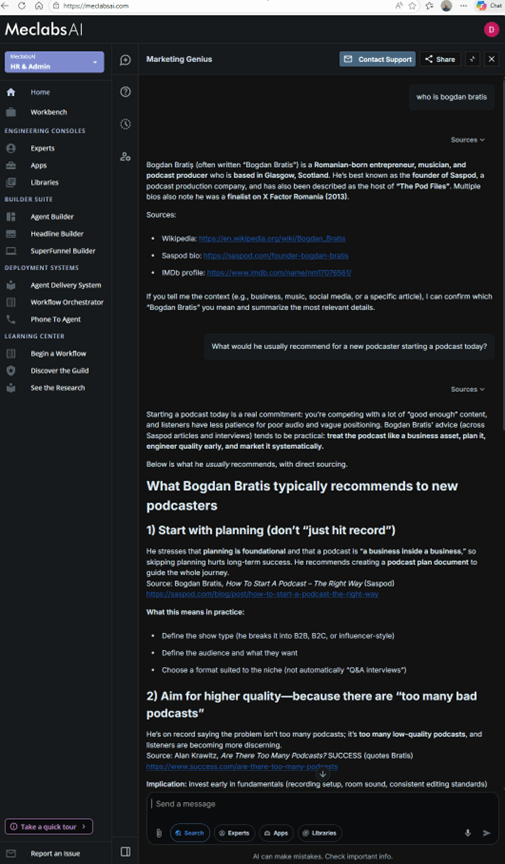
I asked MeclabsAI a second question – ‘What would he usually recommend for a new podcaster starting a podcast today?’ – because Bratis told me that while LLMs rarely hallucinate about him because of the consistent entity spine he built, they can provide advice he wouldn’t normally give.
For example, ChatGPT said Bratis would advise to ‘just get it out there’ while he told me the advice he would actually give is ‘Ensure you record the best podcast possible and don't cut corners on quality.’ His real-life advice was well reflected in MeclabsAI’s response, showing the variability in responses between different artificial intelligence platforms (you can see the full MeclabsAI response here).
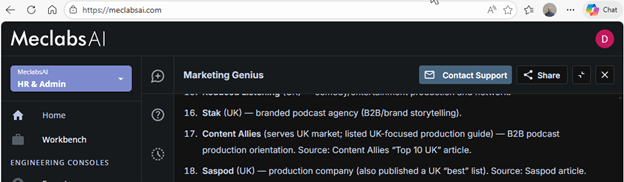
Improving his personal brand recognition in AI responses ultimately helped his company as well. For example, when I prompted MeclabsAI with one of his target queries – ‘What are the 20 best podcast producers in the United Kingdom?’ – his company appeared in the response.
Creative Sample #2: Brand appearance in AI result
“Another metric we measure is the amount of appearances in the ‘AI overview’ by Google. This metric can be spotted in tools such as Ahrefs, for example,” Bratis said. “What I'm showing you here is how Google sees my business which is associated with my personal brand. The baseline was virtually zero.”
Creative Sample #3: Screenshot showing 59 monthly mentions in Google’s AI Overview for podcast production company
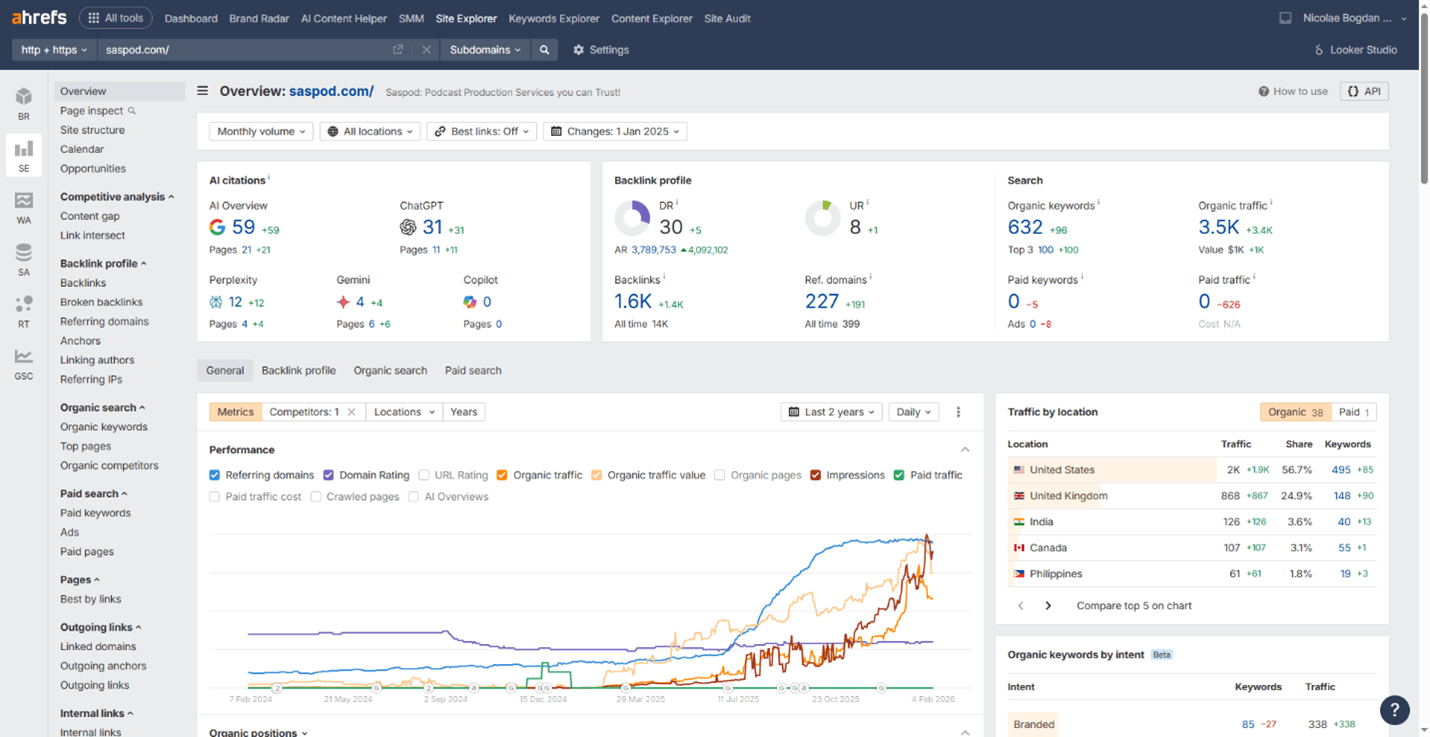
Saspod grew from zero to 3,500 monthly visitors in six months. New clients tell Bratis they found the company through AI-driven results. “I also got invited as a guest on numerous podcasts, and interviewed by other magazines,” he said.
According to the Meclabs value proposition methodology, it’s not enough for customers to think ‘I understand this’ (clarity). They also must come to the conclusion ‘I believe this’ (credibility). “People need to understand before they believe. People need to believe before they will receive,” Flint McGlaughlin has said when teaching about value proposition articulation.
The same is true for large language models. And as they’ve been updated to engage deeper in reasoning, they are programmed (perhaps ‘taught’ is a better word) to be able to justify their answers.
While I focused the case studies in Step #1 to focus on building the entity spine, you can also see in these examples that credibility building was a part of their effort.
In Step #3 we’ll address the credibility building that you can influence on other websites, but in this step, let’s look at on-site credibility building.
Don’t just publish promotional content on your website. Most customers start with category questions long before they type your brand name. If you want to be recognized, you need to show up in the conversations that happen before the brand shortlist is formed.
Create content that answers the questions buyers ask, such as:
Make sure the content is authoritative and truly serves your ideal customer. To this end, you could include original data or real-life case studies. And offer truly helpful (again, not just promotional) information.
Here are two quick examples showing how teams changed their approach – one for a services-based company and another for a product-based site.
“We’ve found that models are more likely to engage with content that mirrors the structure of a textbook rather than a sales pitch,” said Syeda Sultana, chief operating officer, Vettted.
BEFORE
Writing to persuade, with adjectives.
AFTER
Writing to define by making all claims easy to verify with proof.
BEFORE
Writing for the click.
AFTER
Writing for the footnote in an AI response.
“We aren't trying to trick the algorithm; we are trying to be the most organized source of truth in the room. When you structure data in a way that makes it so obvious what you mean that a model must use your definition to explain a concept, you stop chasing the algorithm, and you start teaching it,” Sultana said.
BEFORE
Mugsie, a B2B supplier specializing in DTF (direct-to-film) transfers, just listed products. The site had a low domain rating.
AFTER
The team decided to shift from just being a webstore to becoming a utility-based authority.
For example, they published FAQs with answers to key questions in the industry. They also built free tools like the DTF Ruler Guide and DTF Sizing Calculators. “LLMs prioritize sites that provide value even when a user isn't ready to purchase,” explained Sid Gaffar, founder, Mugsie.
Creative Sample #4: Free tool with no signup required from B2B supplier
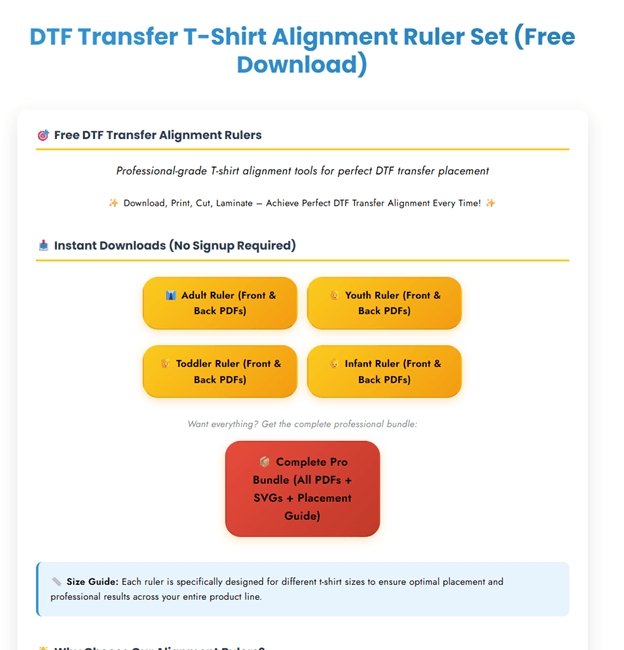
The team focuses on providing the most precise technical specifications in their niche, and then using social proof to show AI models that it is a verified, active, real-world entity…not just a drop-shopping site.
“We use UGC (user-generated content) and real-world video demonstrations on our site and TikTok to prove the physical reality of our data,” Gaffar said.
RESULTS
“Here's a teaser from Ahrefs showing our AI citations. Notice the contrast: Domain Rating of only 2.6, yet 61 AI citations across ChatGPT, Google AI, Gemini, and Perplexity,” Gaffar explained. “You don't need high authority to get AI visibility, you need to be the helper, not the seller. LLMs reward teaching over pitching.”
Creative Sample #5: Ahrefs dashboard for B2B supplier
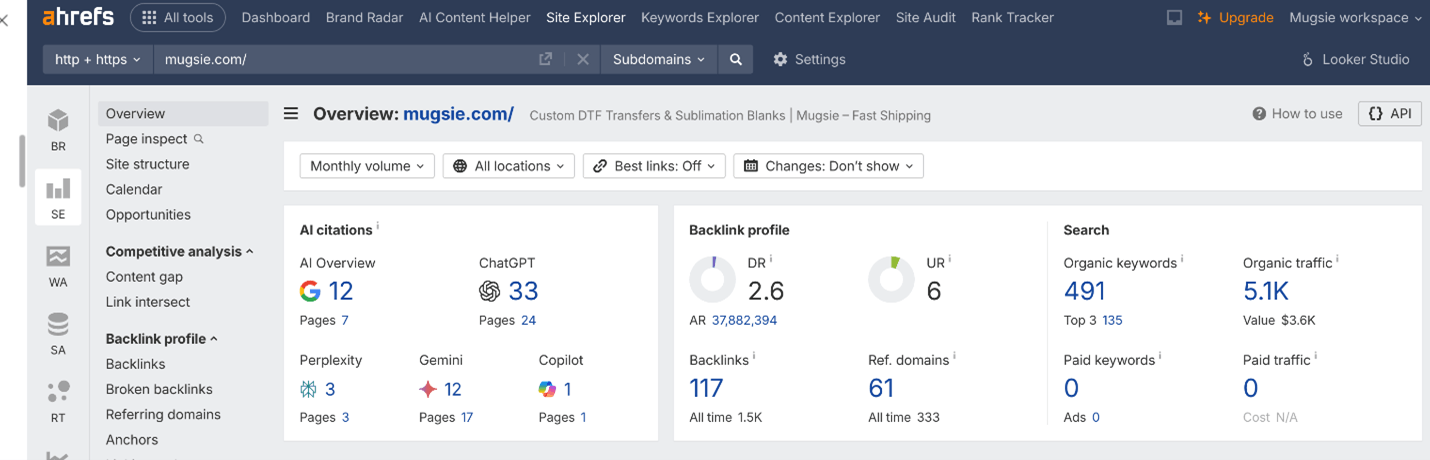
The company has achieved 400% organic growth and attributed $275,000 in revenue to those 61 AI citations.
“We’re preparing for the AI-search era by focusing on helping the user first and selling second,” he said.
In my career receiving pitches as a business journalist, there is a transition I’m seeing first-hand. Earlier in my career I would receive pitches from public relations agencies just seeking the story about their client. Then, I would also start receiving pitches from SEO agencies hoping to get a backlink to their client from a website with a high domain rating. These days, the AEO/GEO folks are also pitching me, and now they’re trying to impress the LLMs.
To get featured in publications, you can pitch their editors and journalists relevant info. One way to find what’s relevant to them is using PR services that connect journalists with experts. I go deeper into what journalists are looking for in this video about tips for pitching journalists to win earned media.
And just like your pitches to journalists should focus on serving an audience, so should your interactions on sites like Reddit and Quora – which means avoiding fake personas, undisclosed affiliated answers, AI-generated mass posting, and brigading to manipulate votes.
Focus on helpful answers in your niche and use consistent language that builds on your entity spine (as discussed in Step #1).
Now, onto some examples. I’ll start with an example that shows why independent corroboration is so important for AEO/GEO, then show an analysis of building independent corroboration with forum-style sites, and finally an example using a traditional PR practice.
BEFORE
The team at GrowByData had a B2B tech client that was ranking well in Google for important keywords, but didn’t come up at all in ChatGPT, Perplexity or Gemini for queries like ‘Best [category] brands’ or ‘Top [category] solutions for [use case].’
The team used its internal analysis platform, GBD Compass, to try to understand why this was happening. “Compass lets us map which sources LLMs cite most, the type of content and structure they rely on, and where a brand is missing in that ecosystem. Through this, we realized that LLMs weren’t just looking at SEO rankings; they were reflecting citation patterns across trusted domains,” explained Prasanna Dhungel, co-founder and managing partner, GrowByData.
AFTER
Based on this discovery, the team worked with the client to:
RESULTS
Within weeks, the brand started showing up in LLM answers for key category queries. Referral traffic from previously unseen domains increased, prospects began mentioning they ‘saw the brand recommended in ChatGPT,’ and branded search around category terms rose.
As the previous case study mentions, Reddit and Q&A spaces are often cited by LLMs, so they are a key place to earn independent corroboration.
“Overwhelmingly, the best place to go is Reddit. The other platform where we have seen success is Quora [a Q&A website],” agreed Bob Bentz, president, Purplegator. “Spend more time on Reddit because Semrush analysis consistently places it in the top position, whereas Quora's rankings fluctuate significantly depending on the month of analysis.”
Reddit has provided the team’s clients with LLM mentions in the following vertical markets: health, consumer technology, personal finance, fitness, and gaming. Quora has primarily benefited clients in business and education.
Local home services have not performed well for the team. “You would think that searches like ‘plumber near Philly’ would be fairly easy to win, but we have not gained the traction we hoped for in this area, at least not yet,” he said.
Medical and legal have not performed well either, for a very specific reason – as a marketing agency, they can’t compete with more authoritative posters. “We can't pretend to be doctors or lawyers even with access to their accounts,” Bentz said. So if you are a medical or legal professional, and willing to spend time on Reddit and/or Quora, you have an opportunity to use your authority to earn independent corroboration that can help you in the LLMs.
The team aims for three meaningful contributions per week per subreddit – 80% comments, 20% new posts. Longer content resembling short articles works best. A list is also helpful, especially for processes with multiple steps.
On Quora, they post from personal (not company) profiles with a headline and bio that shows expertise. And one-sentence answers don’t cut it. They aim for answers with some depth – but not too long – and have found 300 words to be a sweet spot, with structured formatting and subheaders.
As a marketing agency, the team discloses affiliation with a client when posting on Reddit and Quora. “Not disclosing is equivalent to black-hat SEO; it is unethical and becomes ineffective in the long run,” Bentz said. “That's called ‘astroturfing’ and both Reddit and Quora have explicit policies around it.”
Of course, Reddit and Quora aren’t the only places to earn independent corroboration. Here’s an example where a press release backed by a branded methodology strategy helped an agency get LLM recognition.
BEFORE
The agency Evoke Strategy and its methodology was not included in AI-generated answers when marketers searched or asked LLMs about full-funnel PR or PR-to-pipeline approaches. Responses focused on general information about full-funnel marketing/advertising, without inclusion of public relations.
AFTER
The team’s approach is to build the foundation and then build interest around it. They branded their methodology as ‘Full-Funnel Digital PR.’ The team uses the trademark symbol when writing about it, and are planning to trademark the term.
Another part of the foundation building was being clear on their own website with a pillar page, hierarchy and FAQ’s.
Once the foundation was built, they sought to generate interest. “We ultimately ‘went live’ by issuing a press release on Sept 29, 2025 on PR Web,” said Devon Vocke, co-founder, Evoke Strategy. In addition to actively pitching and promoting it for bylines and in podcasts, they used organic social media and ran paid promotion to their pillar pages.
Across all their owned and earned activity, they ensured consistent mentions to help build a clear entity spine.
RESULTS
“Within days of the release we began seeing Full-Funnel Digital PR™ summarized and cited in Google AI Overviews and Gemini for category-level queries. We are (almost always) cited in one of the top positions, along with top search results,” Vocke said. They are also getting more form submission for downloads of their strategy guide.
He believes their effort was successful because they built the foundation on their website first, along with the fact that they already have a 12-year track record as a business.
But the campaign is still a work in progress, and ChatGPT has been “a tougher nut to crack.” Still, the agency does see some referral traffic from ChatGPT, in addition to Perplexity and Rogo.ai.
Vocke also provided details on how they track. “UserMaven was quite easy to use and pretty ‘set it and forget it,’ which is always nice when you’re trying to set up the right foundation. Hubspot is our CRM so all of our data lives there regardless. HockeyStack is great but a bit more technical for implementation,” he said.
How do you know when your AEO/GEO tactics are working?
Seeing referral traffic in your analytics platform is one way. You may also have a platform that monitors AI visibility for you.
But if not, you can get manual (or ask interns or virtual assistants to do so). Build a set of prompts across:
It can help to run these queries in multiple ways that can affect results. For example, the team from Evoke Strategy tests:
This article was distributed through the free MarketingSherpa email newsletter.
MECLABS ICP template for law firms [AI Guild discussion]
AI Guild – Get a free 12-month scholarship
Get Better Business Results With a Skillfully Applied Customer-first Marketing Strategy

The customer-first approach of MarketingSherpa’s agency services can help you build the most effective strategy to serve customers and improve results, and then implement it across every customer touchpoint.
Get More Info >MECLABS AI

Get headlines, value prop, competitive analysis, and more.
Use the AI for FREE (for now) >Marketer Vs Machine

Marketer Vs Machine: We need to train the marketer to train the machine.
Watch Now >Live, Interactive Event

Join Flint McGlaughlin for Design Your Offer on May 22nd at 1 pm ET. You’ll learn proven strategies that drive real business results.
Get Your Scholarship >Free Marketing Course

Become a Marketer-Philosopher: Create and optimize high-converting webpages (with this free online marketing course)
See Course >Project and Ideas Pitch Template

A free template to help you win approval for your proposed projects and campaigns
Get the Template >Six Quick CTA checklists

These CTA checklists are specifically designed for your team — something practical to hold up against your CTAs to help the time-pressed marketer quickly consider the customer psychology of your “asks” and how you can improve them.
Get the Checklists >Infographic: How to Create a Model of Your Customer’s Mind
You need a repeatable methodology focused on building your organization’s customer wisdom throughout your campaigns and websites. This infographic can get you started.
Get the Infographic >Infographic: 21 Psychological Elements that Power Effective Web Design

To build an effective page from scratch, you need to begin with the psychology of your customer. This infographic can get you started.
Get the Infographic >