|
SUMMARY:
It’s almost like a classic romance. They see each other across a crowded room. Their eyes lock. And they finally find their person. Business has a similar two-way street. When you’re the best solution for a customer – and they are the ideal customer for your business – you’ve created a high-value match for both parties. This article lays out a step-by-step framework for service businesses and B2B teams selling high-consideration offers – based on an interview with a business professor as well as Meclabs/MarketingSherpa. We’ve also included real-world examples from your peers to spark your best ideas to put these principles into action. |
Take a look at your current customer base. Let’s be honest, some customers are more valuable than others.
It may be because you make more profit from them over their lifetime relationship with your company. Or because they are more likely to refer you to other customers. They may be early adopters who help you innovate new features. Or they are the clients your team most enjoys working with. I’ve purposefully used the word ‘value’ in the title of this article instead of ‘margin’ or ‘revenue’ so you can decide what is most valuable to your company.
Look at the commonalities of these customers and build an ICP of your high-value clients. “Identifying high-value customers could involve developing a more detailed persona description and then using targeting criteria in Meta channels (Facebook/Instagram) to promote your product or service to these specific interests aligned with your key personas,” said Vanitha Swaminathan, professor of marketing and director, Center for Branding, at the University of Pittsburgh School of Business.
Here is a framework you can use – the Meclabs ICP framework (MeclabsAI is the parent company of MarketingSherpa):
Here’s an example of serving an ideal customer with a very specific orientation and justification.
An Idaho hospital administrator contacted the team at United Medical Education late at night after their contracted training provider cancelled on them for the second time. “This hospital had 140 employees who required ACLS, PALS, and BLS certifications within six weeks, or they would fail an internal audit,” said Brian Clark, founder and CEO, United Medical Education.
The team realized that this ideal customer set needed a dashboard that allowed tracking of all roster entries, expiration dates, and test scores. By creating it, the administrative burden for hospital administrator decreased by approximately 60% due to no longer having to search through departments for missing paperwork. Within eleven days, employee completion increased from 72% to 100%, and the hospital paid $38,000 for the contract.
This led to three additional system referrals and increased average contract amount from $8,000 to $22,500 per month.
“High-value customers show up at the right time because you have solved a particular problem for a customer at the precise moment a customer has been placed in a box,” Clark said.
If the team had used the Meclabs ICP approach in this example, it might look like this:
Clients that provide a lot of value to your business will only do so if they perceive that they will receive a lot of value. This is why formalizing your value proposition is so helpful for all your marketing, business, and operational choices. This step can provide the epiphany moment that helps you make the business changes necessary to have a high-value offering worth messaging and formalize throughout your organization (and vendor partners) how it should be messaged.
A value proposition is the reason the right prospect should choose you over alternatives. According to Meclabs methodology, your primary value prop should answer this question – ‘If I am your ideal customer, why should I buy from you instead of any of your competitors?’
Since you’ve outlined an ICP in the previous step, you can now craft a value proposition that is tightly focused on your ideal customer.
Based on tests conducted by Meclabs’ team, an effective answer to that question should include these elements:
You can do this exercise on your own, or with a team. Either way, once you’ve crafted a value proposition with credible specificity, it’s important to get feedback from all key stakeholders, and ultimately roll it out to every person and vendor who creates work that touches the customer. The value prop should guide all messaging and positioning.
There will be scrutiny, of course. Everyone will have their opinions. When challenged, try to mitigate internal bias by always bringing the answer back to the ideal customer (again, where your ICP can help).
I want to specifically call out the Appeal element since we’re talking about high-value clients. Some of the appeal may be in how you deliver a product or service, not just what you deliver. Clients will pay more if they value that how. “Some industry examples that I describe in the book include Patagonia (purpose statement focused on sustainability), and Toms Shoes, where the purpose statement really reinforces the value that the company provides,” said professor Swaminathan, author of Hyper-Digital Marketing.
This overall approach of crafting a value proposition should increase customer curiosity throughout your company and your vendor partners, so you can better understand their needs, actually better serve them, and as a marketer, more clearly communicate that you can better serve them so they perceive that value. Like in our next example.
BEFORE
The language on a virtual office company’s website was generic. For example, it generically referred to ‘perks’ and ‘flexible options.’
AFTER
To better understand the specific challenges of the ideal customer, Elliot Sterling went through client chat logs, support tickets, and forum complaints to identify common pain points:
Based on what Sterling discovered, he was able to craft copy that was clearer and more compelling. For example, the new copy made specific statements about the challenges of being an executive (like mail and phone issues). Instead of vaguely referring to options, it now has a clear offer – ‘Secure a Fortune 500 address to sort your mail and answer calls so you can focus on closing deals for $99 per month.’
He also created pricing tiers to serve different segments within the ideal customer set:
RESULTS
Inquiries have increased 65%. The average booking value increased from $120 to $285.
“Service providers should scan their homepage for one executive problem to solve, ask five prospects for feedback, and listen to calls for two weeks,” advised Sterling, web content writer, Opus Virtual Offices. “Talk about the problems your prospects are talking about and make it easy for them to take action.”
Now that you have clearly defined who you can most profitably serve and are clear on how your brand serves them, you need to present them with an offer.
While you ultimately want to acquire high-value engagements and sales, for most products or services, you will not be able to do that right out of the gate. What makes a client high value can also make them hard to attract – namely, they are willing to give you a lot (pay a high-margin price, invest a lot of their time, etc). They will not do that until you’ve built up trust.
To begin to crack the door open to that relationship, create a wedge offer – low risk, proves capability, clearly scoped, and directly tied to a meaningful business outcome. “For example, many services (such as Canva, Dropbox, LinkedIn) offer a free tier to enable future clients to learn about the product or service,” Swaminathan said.
Here’s a concrete example Flint McGlaughlin shared of an AI-enabled wedge offer that amplified a value proposition and improved lead quality.
“This is a tool,” said McGlaughlin, CEO, MeclabsAI. “[And] his clients are finding a new way to experience his personal value proposition.”
A helpful framework you can use when creating your wedge offer is the Meclabs Customer-First Objective (CFO) approach:
How can you help an ideal prospect begin to achieve a high-value outcome? Here are some examples of wedge offers:
This wedge offer doesn’t need to be entirely new. You may be able to add more value to and re-envision a current element of your process, like in this next example.
BEFORE
Dry Top Roofing offered free estimates, focused on price.
AFTER
“The biggest shift for me was realizing that high-value clients aren’t just looking for the cheapest price – they’re looking for someone they can trust to get the job done right,” said Dylan Simonson, owner, Dry Top Roofing. “The biggest change was getting out of my own head and thinking more like a homeowner.”
When a homeowner with a luxury property was planning a full exterior upgrade, Simonson offered more than an estimate. He provided a free diagnostic inspection with a detailed plan, showing options and long-term benefits.
RESULTS
The homeowner loved the results and referred three of her neighbors, all high-value clients. That one project was 40% more profitable than the average job at the time. Plus, it became a showcase project for the roofing contractor’s portfolio, helping attract more luxury clients through word-of-mouth and online.
And now, the company takes the diagnostic approach. “We’re very thorough upfront. Inspections are detailed, with photos and notes, and the proposal clearly explains what we’re recommending and why. Especially on higher-end homes, clients want to understand the logic behind every step, not just see a price,” he said.
A good wedge offer may involve risk for the prospect, because it might require you to get inside their business, receive private information, have employees invest their time with your business, etc.
And that’s not just for B2B. Even something as simple as the roofing company example in the previous step might require a homeowner to take time off of work and allow a stranger to walk around on top of their roof. That involves risk. For example, an estimator stepped on a soft spot on my neighbor’s roof and poked a hole in it…but never told them. They only found out when rain poured into their garage during the next thunderstorm.
There are two ways to build credibility to overcome the anxiety of the risk to your ideal customer.
One way is how you promote the offer. Make sure your messaging communicates:
The other way to build credibility by publishing content that helps your ideal prospect even if they never buy from you. Make your credibility content AI-findable (known as AEO, Answer Engine Optimization) since many B2B and B2C customers are now using artificial intelligence to research the credibility of companies before they purchase.
“AI tools prefer content that answers questions directly without requiring users to hunt. For example, the following is an AEO-optimized answer for what MarketingSherpas does,” Swaminathan said. (Editor’s Note: The following example was provided to illustrate AEO formatting. Some details are placeholders and are not intended as verified facts about MarketingSherpa.)
MarketingSherpa is a research institute that publishes case studies, benchmark data, and how-to content for marketing professionals. Founded in 1999, MarketingSherpa provides evidence-based insights on digital marketing tactics through detailed case studies showing what works (and what doesn't) in real campaigns.
Core Offerings:
Case Studies: 3,000+ documented marketing campaigns with ROI data
Research Reports: Original benchmark studies and surveys
Training Resources: Email marketing summits, webinars, certification programs
Newsletter: Weekly insights delivered to 500,000+ subscribers
Parent Company: MECLABS Institute (sister brands include MarketingExperiments)
In addition to creating content for AI, determine what formats would serve your ideal human customers, like in this example.
BEFORE
When NetSolutions rebranded to Experience Care, the company had a credibility problem. “People didn't know us and in healthcare longevity and perceived security are critical to sales growth,” said Jason Long, CEO, Support My Website.
Long was CEO of Experience Care (which was acquired by WellSky in 2023), the fifth largest electronic health records (EHR) company in the US at the time. He shared with me how the team built their credibility stack by creating helpful (not sales-driven) content.
AFTER
Their target market was nursing homes, and one of the biggest problems nursing homes faced was staffing shortages. So, they created content to help their ideal prospect solve that pressing problem…even though that’s not the solution they sold.
“Staffing is a huge issue, so we tested multiple ways to use outbound LinkedIn, outbound email, and Facebook/Linkedin ads to find local, trained staff instead of going through staffing agencies,” said Long said. The marketing team then did sessions at tradeshows that taught the system they created, including a QR code to get the information.
Another way they built credibility was creating a podcast called LTCHeroes for long-term care employees. They published interviews with industry VIPs and executives but also told stories from the front line – people that never get interviewed such as cooks, CNAs, and janitors. These were some of the most listened to and most emotional interviews.
“The important thing was that we ALWAYS kept LTCHeroes a separate entity from the main business,” he explained. It wasn't a promotional podcast for the EHR company, it was an industry podcast that the team happened to sponsor (and staff). “Peter Murphy Lewis was both our podcast host at LTCHeroes and our VP of Marketing at Experience Care, but surprisingly, I don't think anyone ever put it together,” Long said.
They reached out to industry events and got booked to do live podcasts because these tradeshows weren’t inviting just another vendor, but a true resource. The podcast became popular enough that they were able to ask for a booth for the sponsor (Experience Care) as well as room and board for the team.
But they didn’t only rely on their own podcast to build credibility, they guested on other shows as well. “We use Podcast Hawk to get onto those shows,” Long said.
RESULTS
At the tradeshow staffing sessions, nearly all (95%+) of attendees who scanned the QR code ended up on the company’s newsletter. These sessions brought in 20 to 50 leads per tradeshow for the main product.
Many of these people were not decision makers, but the company helped them anyway, which ultimately got them in front of decision makers.
For example, they had a big group from one company show up to a talk and got 30 signups from just that group. The group was in the market for a new EHR system. They saw what Experience Care had to offer from its emails, and finally the word got up to the CEO who wasn't even at the conference. About a year later they became a client. So from the actual list, 0% of people became a client, but they generated a $35,000-per-year sale for a three-year contract from that list.
The podcast helped increase leads and (along with a number of other initiatives) bring down churn rate from 20 to 30 percent a year to three percent. When they sold the business, they were getting invited to two shows per month.
The ICP you built in Step #1 can help you target your campaigns. “For B2B, LinkedIn works well. For B2C it varies by category, type of audience etc,” Swaminathan advised.
You can get even more focused and identify specific groups of companies that would be a strong fit. This approach can provide a middle ground between true, one-to-one account-based marketing (ABM) and broader campaigns. For example, you could:
If you’re looking for ideas to launch your own ABM Lite campaign, here’s an example.
When Alex Boyd ran a marketing agency, he built a custom engagement feed of prospects' LinkedIn content, so he could comment on it. He emphasized that all of his comments were thoughtful, and he did not use AI.
“With the combination of targeted, manual/thoughtful engagement, plus my own thought leadership content, I would see four to seven unique leads per month either DM me directly or submit a 'contact us' form on our website citing that they heard about my agency from LinkedIn or a certain community I was part of,” explained Boyd, co-founder, Wildfront.
He shared his most successful example – he once spent 12 seconds writing a short but insightful comment on a friend’s post. The friend’s client, who didn't engage publicly, DM’d Boyd to say, ‘Your company looks like the perfect complement to what we need this coming quarter. I have spare budget I need to use – can we get on a call and potentially get a purchase over signed by the end of the day so I can deploy this budget before I lose it next quarter?’ “And that's how we won the easiest $40,000 agreement of our history!” Boyd said.
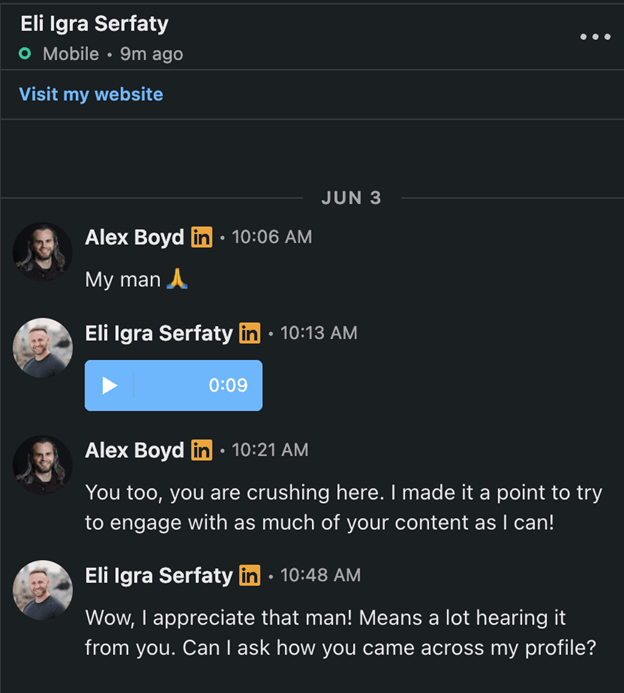
In addition to commenting, Boyd also sent direct message. “Instead of building a large list and sending a ‘campaign,’ I would send DMs as if they were the equivalent of approaching someone at a conference. Lower volume, and intentional yet informal. I have always found that 10 Strike-Up-A-Conversation DMs are worth 10,000 mass-blast DMs,” he said.
Creative Sample: Direct message example
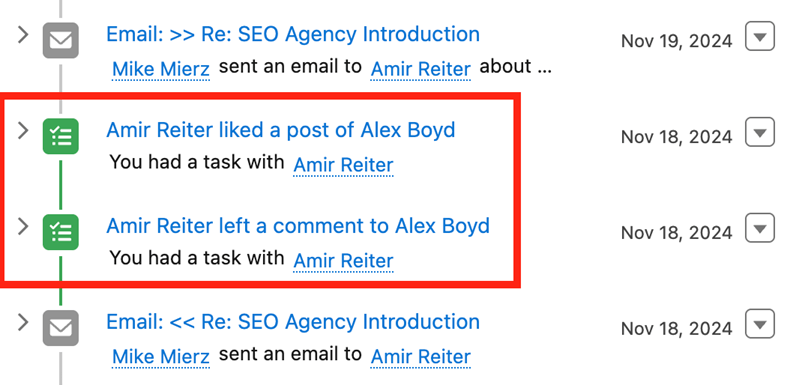
Boyd used a CRM to track his efforts. “For example, with my past marketing agency business (also since exited), I used Salesforce with Lead Source fields on each Lead/Opportunity, to denote the source – such as, from LinkedIn. Then in the notes or sub-source field, I could track a particular post, interaction, or thread,” Boyd said.
Creative Sample: CRM activity timeline with blended emails and LinkedIn activities showing attribution of sales opportunities
Success will require discipline. After all, even if you do some vetting on the front end, not every company you identified will become a high-value customer.
For example, the company may have seemed a good fit when you did your research externally, but once you get a better understanding of what they’re looking for, it might not align with your high-margin offerings.
A qualification gate can help you collect the information along the way to better understand if they are the right fit. This could be anything from questions in a lead gen form, to the way you execute the wedge offer to learn more about the company.
Once you determine what it takes to be a high-value client – revenue thresholds, required commitments, etc. – then you can better focus your lead management efforts. “There are now a number of AI tools (Salesforce, Relevance AI) that can help you qualify your leads,” Swaminathan said.
What knocks it out of the park for one ideal customer set may feel like stepping on a rake if you try it with another ideal customer set.
So as with any marketing initiative – play, experiment, be curious…and ultimately learn.
One way to discipline your efforts is to write hypotheses in a structured format. One structure you can use is the Meclabs Scientific Messaging Hypothesis:
Here are some examples:
When creating your hypothesis, you should also consider the timeframe over which you expect to see an improvement in metrics. For direct response tactics, you may be able to measure efficacy fairly quickly. However, you may have to stick with other tactics for a longer timeframe to truly measure their efficacy, like in our next example.
BEFORE
Search engines did not clearly understand the specific solutions Grid Dynamics offered or the audiences those solutions served, so the enterprise technology consulting firm was not getting high-intent queries.
AFTER
“We combined SEO opportunity analysis with Grid Dynamics’ internal business priorities, strategic goals, and revenue centers. This ensured that optimization efforts targeted opportunities with the greatest potential business impact,” said Chris Rodgers, founder and CEO, CSP Agency.
The team developed detailed personas and built a persona matrix to drive its SEO and GEO (generative engine optimization) work. For example, bottom-of-funnel pages were carefully aligned with audience needs and optimized to clearly communicate unique value propositions.
RESULTS
Early indicators appeared within four months. More significant and sustained gains became evident by month seven as content, authority, and technical improvements compounded.
The effort helped increase organic traffic 73% and non-branded organic traffic 48%, helped to produce 4,221 lead submissions. Of these submissions, 20% were viable leads. Eight of these leads ultimately became paid projects, resulting in a 5,342% ROI.
Ask MarketingSherpa: How do small businesses find clients?
Scale Without Sacrifice: 7 proven steps to grow your agency and keep every client happy
Strategy: Don’t think of your customers as a ‘target’ to acquire (podcast episode #65)
Get Better Business Results With a Skillfully Applied Customer-first Marketing Strategy

The customer-first approach of MarketingSherpa’s agency services can help you build the most effective strategy to serve customers and improve results, and then implement it across every customer touchpoint.
Get More Info >MECLABS AI

Get headlines, value prop, competitive analysis, and more.
Use the AI for FREE (for now) >Marketer Vs Machine

Marketer Vs Machine: We need to train the marketer to train the machine.
Watch Now >Live, Interactive Event

Join Flint McGlaughlin for Design Your Offer on May 22nd at 1 pm ET. You’ll learn proven strategies that drive real business results.
Get Your Scholarship >Free Marketing Course

Become a Marketer-Philosopher: Create and optimize high-converting webpages (with this free online marketing course)
See Course >Project and Ideas Pitch Template

A free template to help you win approval for your proposed projects and campaigns
Get the Template >Six Quick CTA checklists

These CTA checklists are specifically designed for your team — something practical to hold up against your CTAs to help the time-pressed marketer quickly consider the customer psychology of your “asks” and how you can improve them.
Get the Checklists >Infographic: How to Create a Model of Your Customer’s Mind
You need a repeatable methodology focused on building your organization’s customer wisdom throughout your campaigns and websites. This infographic can get you started.
Get the Infographic >Infographic: 21 Psychological Elements that Power Effective Web Design

To build an effective page from scratch, you need to begin with the psychology of your customer. This infographic can get you started.
Get the Infographic >