|
SUMMARY:
AI can do a lot of the work that used to differentiate you. But it can’t adjust its approach based on lived experience. It doesn’t have an original point of view. And it makes ‘sneaky’ mistakes that require human oversight to fix. Read on for real-world examples from your peers to give you ideas for how to build a career and business powered by AI, not replaced by it. |
[Action Box] Transparent Marketing, Part 2: How to earn the trust of a skeptical machine
In the age of LLMs, this timeless principle is even more important to driving revenue. Join us for a free AI Guild session on Tuesday, October 13th at 2:00 pm EDT. Register now (from MECLABS AI, MarketingSherpa’s parent company).
You are a product.
Whether you are an employee of a company, a consultant with clients of your own, or an entrepreneur running your own startup – you are a product.
And you serve a need for your customer(s) – whether that’s an employer, a client, or even people you manage who report to you.
Of course, the year is 2026. So for many marketers, entrepreneurs, and other knowledge workers, there is an elephant in the room. Why not just choose AI instead of you?
To compete, you have to double down on your key human skills. And then amplify those skills with artificial intelligence.
Let’s be real. Like with many things, AI does a pretty good job at this.
But it still requires a human gut check.
It reminds me of the scene in “Good Will Hunting” where Robin Williams’ character tells Matt Damon’s character that book knowledge is no substitute for real-world experience.
Among other things, Williams says, “[If] I'd ask you about war, you'd probably throw Shakespeare at me, right, 'Once more unto the breach, dear friends...' but you've never been near one. You've never held your best friend's head in your lap, watching him gasp his last breath looking to you for help."
Some of you reading this may know exactly what this feels like. You may have experienced war or held someone you cared about while trying to save their life. For those of us who have not, that is exactly the point. Knowing about an experience is not the same as living it.
That reminds me of artificial intelligence’s role in audience analysis. It can do an amazing job or helping you learn more about the humans who are your customers, but still…it’s not human and you are.
That’s why in the newest version of MECLABS AI (MarketingSherpa’s parent company) there’s an edit button on the ideal customer profile (ICP).
Creative Sample #1: Product Strategy Brief in MECLABS AI
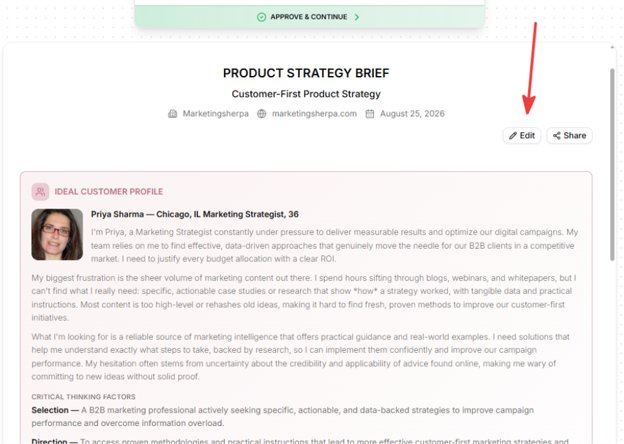
Yes, it does an amazing job building an ICP. But it’s still incumbent on you to know your customers and prospects on a human level and nudge the AI where it needs to go.
There are many ways to better understand these humans on a deeper level. Analytics. A/B testing. Social media listening. Forum comment analysis. But don’t overlook your human ability to interact with fellow humans. That could be at live events or through video conference or phone conversations or email…even when you get no response.
“If I'm contracted to send three to four pitches a month but I haven't secured a feature in two to three months, I know my approach needs to change. If the opportunities have strong potential and there aren't known seasonal factors, I narrow it down to adjusting the way I talk to the sources,” said Jewel Savoy, digital PR strategist, tiptop SEARCH + MARKETING.
Here’s an example of how Savoy changed her tone.
Savoy was pitching in an industry with 25-40-year-old men who are busy and confident – online golf gear review publications with high authority and high monthly organic traffic. Here was her first pitch attempt.
Creative Sample #2: Original pitch email with client name redacted
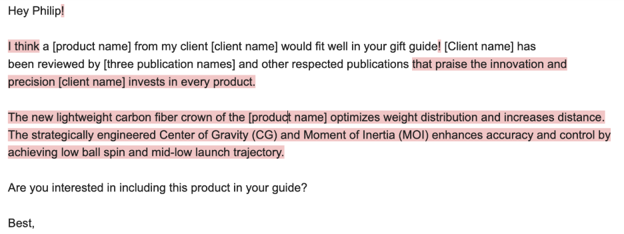
“I highlighted in red the parts that make me cringe, now that I know the target audience better,” she said.
Her new approach with this audience is to be concise, straightforward, and professional. She avoided promotional language they'll glaze over as meaningless and irrelevant as well as product information they can read on the website.
Creative Sample #3: New pitch email with client name redacted
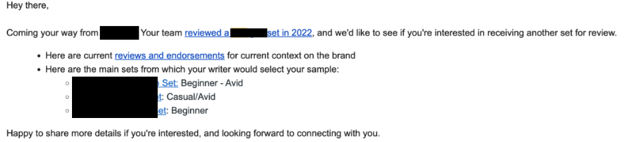
With the new approach, she secured agreement for review of her client's product in a full-length article, inclusion in their active newsletter, and a feature on their social media.
But that’s what she learned about this audience specifically. She treats other audiences differently. For an equestrian content creator on YouTube, she used exclamation points, smileys, encouragement, and clear next steps.
For a managing editor of medium-size publication providing operational, financial, and regulatory insights for physicians and practice managers, Savoy focused on relevant and timely information in an easy-to-scan format that doesn’t require many follow-up questions.
Editor's Note: The paragaraph after the Robin Williams quote at the topic of this section was written by a MarketingSherpa reader, and added after the publication of this article. Read his full letter to the editor, and the lessons all marketers and entrepreneurs can learn from it, in Letter To The Editor: Audience analysis, blind spots, and human experience in the AI era.
I received a pitch that combined these two and I think that’s a perfect way to look at it. To me, writing is thinking. If you outsource all your writing to AI, you also outsource your thinking.
When I’m trying to solve a creative challenge, I sit down and just start writing. A landing page. A print ad. An email. Heck, this article.
In fairness, I’m a writer. It’s my trade. But I’ve seen this apply to a wide variety of disciplines. Sitting down to write forces you to think through a challenge and hone your ideas down to a crisp edge.
One way I learned this was with MarketingSherpa’s How I Made It In Marketing podcast. When I first started I tried having a pre-call with interesting people to learn their story and, most importantly, what value they could bring to the audience. Even for masterful, high-level, career communicators, these calls were all over the place. And I did not want it to be yet another podcast with two people just yammering on.
I wanted How I Made It In Marketing to have real, clear lessons and examples that marketers and entrepreneurs could apply to their own careers. Moving to a written application resulted in greatly refined, clearer episodes. By having to sit down and put pen to paper (even when the pen was sometimes in the hands of a PR rep and they were just reviewing and editing the application), helped create much clearer episodes with concrete takeaways for the audience.
Now, AI is a wonderful thinking and writing assistant. But like any good assistant, while you can outsource your hands, don’t outsource your brain.
“You have to develop your ideas, synthesize across unexpected domains, and add your own perspective and lived experience before turning to an LLM. For my recent articles at Channel RVA, I start by mulling the idea over to assemble the relevant pieces, then voice-to-text a lengthy brain dump into a Claude project I use for research and sharpening my through-line before I write,” explained Courtney Turrin, chief work officer, Xponent21.
Turin shared one of her raw voice-to-text dumps with me, and when I originally asked her for it I intended to publish it in this article. But I think what’s actually more helpful for you (and more concise in the article) is Turin’s self-reflection when presenting it to me.
“I record these voice notes as raw material and never expected anyone else to see one,” she said. “There is a specific person with a specific way of thinking behind the finished piece, and you can hear me fumbling toward an angle in real time. In an age when anyone can generate polished copy on demand, that fumbling is the part a machine cannot fake.”
For another piece, Turin used those original thinking skills to create a headline that reduced reader avoidance by not using the word ‘homelessness,’ while at the same time making sure AI crawlers had the info they needed to refer the article:
“Lilian Raji over at Forbes alluded to this exact skill at the start of 2026, but I think it's time that it gets taken more seriously,” said Katie Passarello, director of PR, The Pitch Club.
Media mentions are critical to AI discoverability because they give the trusted signal sets that help boost AEO/GEO. And even when many online articles are written by AI – “The number of articles published on the internet that are primarily AI-generated (50%) is equal to the number written by humans (50%),” according to May 2026 research from Graphite Growth – not the good stuff. The content AI itself trusts is still written by humans.
So even in an age where AI can pretty much build the company for you, you still need to give it that first kernel of original thought to work off of. That piece of grit to build the sand around. Like George Jetson, the ‘digital index operator’ who’s job was to simply go into the factory and push the button to get the whole machine started, the company starts with a human idea.
An idea you can tell a story around, like this example.
“Jaime Holm, founder and VP of design at Tinker Tin, adamantly did not want her founder story in the press,” Passarello said. She was worried her humble origin story would confuse prospects about what her now established manufacturing and design company offered since their capabilities had grown significantly.
But the team decided to lead with that origin story in their pitch – ‘This Brother/Sister Duo Went From Flipping Camper Vans to $20M in Manufacturing For Big Name Brands.’ In the pitch, they transitioned from the early days to copy that highlighted the current product mix, like ‘This new iteration led to Coachella stage sets, and design props for Miranda Lambert's photoshoots.’
“It turns out it was exactly what Entrepreneur Mag wanted. So much so that her story appeared not only on their digital site, but also on their Instagram and as the headline piece for the Entrepreneur Newsletter, hitting over 110,000 inboxes the week after the article went live,” Passarello said.
The original article garnered 41,000 unique views, and an additional article that featured Jamie and her brother/co-owner Matt Hannula got 21,000 unique views. “Historically, we have used RELEASD for coverage view metrics,” she said.
Like all the human skills in the article – this isn’t new. In fact, MarketingSherpa’s sister publication MarketingExperiments was a pioneer in publishing about online A/B testing at the turn of the century.
As I’ve mentioned before, AI is a bit of a parlor trick. So when it gives you a suggestion – for a headline, for a CTA button – it’s easy to feel like it knows the exact best headline for your marketing.
But this isn’t new to anyone who’s been in the room with a very persuasive consultant or ad exec.
The same rule applies – let the customer decide. This is where the human skill of having the experimentation discipline to establish a hypothesis and test with real flesh-and-blood prospects making real-world decisions.
There is a new experimentation discipline that has emerged as well – ensuring AI agents and workflows working on behalf of your brand are accurate and effective. Here’s an example from an aluminum manufacturer that automated its sales process.
A deal closed on a phone call, and then a human:
The call itself was not recorded. The company used this process for roughly 100 calls per week.
The team automated this process. Much of the automation was deterministic.
“The pink box on the right is the AI's only seat at the table: an agent (OpenAI chat model, conversation memory in Postgres) that messages the surveyor on WhatsApp to check availability and book the measurement, and drafts the customer's status update in Hebrew. Every step writes back to Airtable, so every run is auditable after the fact,” said Achiya Cohen, founder, Achiya Automation (the aluminum company’s automation agency).
Creative Sample #4: n8n sales process workflow for an aluminum manufacturer
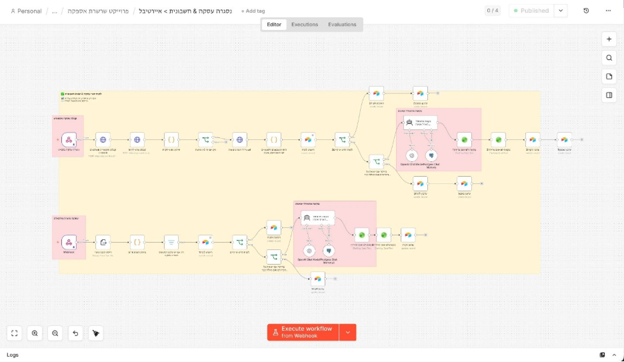
To test the workflow, they used the following process:
“On the aluminum build the AI surface is narrow – classify incoming calls (new customer/ technical question/spam), extract contact details, draft status messages in Hebrew – so the bar was exact-match on fields and labels against real calls,” he said.
Cohen’s discipline is instructive here: when outputs affect invoicing, scheduling, or CRM records, there’s no partial credit. It’s exact-match or fail.
Through their experimentation, here are the top three failures the team caught which Cohen listed for me in order of “sneakiness:”
The client estimates that the new, automated process saves about 14 hours per week.
More human skills
This is not an exhaustive list by any means, just a focus on a few of the top human skills marketers and entrepreneurs should master in this new world we’re living in that is so heavily influenced by AI. And it’s a topic we’ll further explore in MECLABS’ AI Guild in the months and years ahead, to help you navigate your career and business by mastering uniquely human skills and then amplifying the execution with artificial intelligence.
This article was distributed through the free MarketingSherpa email newsletter.
Related resources
Guide to getting websites cited in AI answers
The New Economics (and Philosophy) of Value in the AI Era [AI Guild session replay]
Roundtable Discussion: What human skills should you hone for the AI era?
AI transparency
This is a human-conceived and -written article, assisted by AI. MECLABS AI was used to review source pitches for artificial intelligence usage, evaluate the credibility of potential sources, craft follow-up questions to sources, brainstorm the steps and advice in this article, create Open Graph and CMS thumbnail images, and provide copy-edit suggestions for the article.
Get Better Business Results With a Skillfully Applied Customer-first Marketing Strategy

The customer-first approach of MarketingSherpa’s agency services can help you build the most effective strategy to serve customers and improve results, and then implement it across every customer touchpoint.
Get More Info >MECLABS AI

Get headlines, value prop, competitive analysis, and more.
Use the AI for FREE (for now) >Marketer Vs Machine

Marketer Vs Machine: We need to train the marketer to train the machine.
Watch Now >Live, Interactive Event

Join Flint McGlaughlin for Design Your Offer on May 22nd at 1 pm ET. You’ll learn proven strategies that drive real business results.
Get Your Scholarship >Free Marketing Course

Become a Marketer-Philosopher: Create and optimize high-converting webpages (with this free online marketing course)
See Course >Project and Ideas Pitch Template

A free template to help you win approval for your proposed projects and campaigns
Get the Template >Six Quick CTA checklists

These CTA checklists are specifically designed for your team — something practical to hold up against your CTAs to help the time-pressed marketer quickly consider the customer psychology of your “asks” and how you can improve them.
Get the Checklists >Infographic: How to Create a Model of Your Customer’s Mind
You need a repeatable methodology focused on building your organization’s customer wisdom throughout your campaigns and websites. This infographic can get you started.
Get the Infographic >Infographic: 21 Psychological Elements that Power Effective Web Design

To build an effective page from scratch, you need to begin with the psychology of your customer. This infographic can get you started.
Get the Infographic >