|
SUMMARY:
I was tempted to call this article – How AI makes you a better marketer (it’s not what you think). The plot twist would be that we’re so focused on what AI can do for us, we overlook what we need to do for it. If you want to win in AEO/GEO, you need to focus on clarity, credibility, relevance, and reducing friction in how people find and trust information. Those were always core elements of being a customer-first marketer. And now LLMs are forcing us to adopt those practices. We show you examples in this article. Read on to learn how the new behaviors for AI systems are simply old marketing truths in a new delivery environment. |
The Once and Future Landing Page: Conversion optimization in the AI era
Join digital marketing pioneer Flint McGlaughlin for this live, interactive AI Guild session on Wednesday, November 4th at 2:00 pm EST. Register for the session (from MECLABSai, MarketingSherpa’s parent company).
Before we get started, a few simple definitions for any marketers or entrepreneurs who are just starting out:
Before we get into tactics and technicalities, let’s begin with the real goal – to serve man.
Normally I would say ‘serve humans’ and use a more accurate non-gendered word, but anyone familiar with “The Twilight Zone” will get the joke. In a famous episode, aliens come to Earth claiming to be benevolent and only looking to help. They even have a book titled To Serve Man.
Spoiler alert (from 1962) – it’s not a book about helping humans…it’s a cookbook.
This is the perfect analogy in the age of artificial intelligence. We’re so focused on getting AI to serve up the answers we want.
Stop.
AI is a means to an end. Always begin with the end in mind (as Covey would say). And that end is to actually serve (this time, the ‘offer assistance’ definition of the word) other human beings.
You serve them through AI. You never serve AI itself.
Here’s an example to get you thinking.
BEFORE
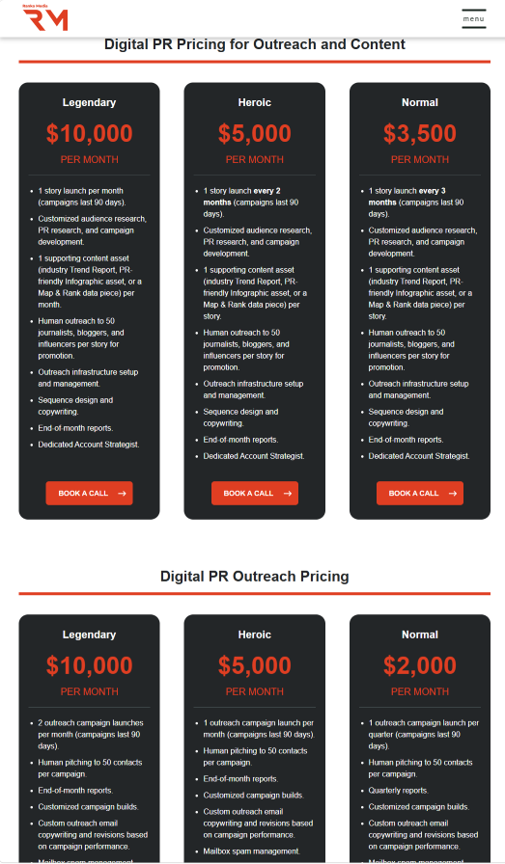
The team hid their pricing and would only reveal it on a call.
AFTER
“For us, going after the bigger search terms like ‘digital PR agency’ and ‘SEO agency’ won’t work, so we had to think long tail, and think about how our customers are using these platforms to choose agencies,” said Nick Rubright, founder and CEO, Ranko Media.
In Q1 of 2026, the team asked 20 existing clients and 100 incoming leads in varying industries how they shop for agencies with AI. Some even sent the team their entire chats.
The team discovered that when their ideal prospects used artificial intelligence to find agencies, they would specify what they were looking for based on how the agency operates (for example, ‘doesn't buy placements’ or ‘no guest blogging’) and then would add a price filter (like ‘Under $5,000’).
So the team published its pricing and packages on its website, to make it available to LLMs answering these types of questions for people.
Creative Sample #1: Transparent pricing on agency website
RESULTS
In January 2026, the team didn’t book any calls from AI search. Now, they are booking four to 10 calls per month.
“We have a ‘how did you hear about us?’ field on our booking page,” Rubright said. “Many people are putting ‘AI search’ or ‘AI’ or ‘ChatGPT’ even if the tools are attributing them to direct traffic,” Rubright said.
A lot of the chatter around artificial intelligence focuses on how it’s a disruptive technology that will change the working world as we know it.
But here’s something else I’ve noticed in some cases – AI is making what was always true even truer.
Makes sense. After all, AI seeks to learn from and mimic human activity.
One place I’ve seen that this is true is for attributing information. We all learned this in school, and then many of us got into the working world and forgot all about it.
As a business journalist, I’m like a human version of AI. When I write an article, I have to decide which information to include and which to filter out. Much like an LLM does in crafting a response to a query.
PR reps, marketers, and entrepreneurs love pitching data. There is a certainty to it. But I’ve received so many pitches where there was no source for the data. No explanation of the methodology for collecting the data.
Or they would offer up a source, but upon further investigation I found it was a link to a secondary source (for a good piece of data, I’ve gone down the wormhole of clicking blog posts that reference other blog posts that reference other blog posts that on the seventh mention finally get to the original source).
Less often (but still happens) – I get pitched info from a company or sent to a blog post or article on a site that was written by nobody. Companies don’t say things. People do. And at MarketingSherpa, we need a real human being to stand behind a statement.
Lastly, I’m sometimes pitched a big glob of information with no clear point. These are people overlooking the classic journalism ethos ‘don’t bury the lede.’
None of these foibles mean I absolutely won’t include info in an article. Sometimes I can tell there is a golden nugget buried under all the crust and it’s worth panning for. But it is extra friction and anxiety that makes it less likely I’ll use the information.
Same for how large language models make decisions. I would never definitively say that using or abstaining from a particular tactic will make AI act or not act in any way. But I will say when you make it clearer what the answer to a question is and what credible source is providing the answer, you increase the chance of getting cited.
Here’s an example of improving identity attribution and extractability.
BEFORE
AI crawlers were reading the site heavily but sending almost no visitors back – 77 pages read for every one visitor referred. “They took everything and recommended nothing,” said Gabriella Timea Sinka, founder & SEO/AI visibility consultant, TimeSaver.
And those were only from crawlers that downloaded the HTML. For AI agents that load the page in a real browser, they were getting blocked by a cookie-consent banner.
Sinka discovered the cookie-consent issue while implementing WebMCP to let AI agents use the contact form, site search, and booking. “Checking it in the browser's developer tools (F12), the agent tools simply weren't registering: the consent tool was holding back the script that makes them available,” she said.
Also, Sinka didn’t have a byline on her posts because it was a one-person business blog and she was already listed in the ‘about me’ section.
AFTER
She updated her site’s content templates with a visible summary panel titled ‘A lényeg elöl” in Hungarian, which translates to ‘The point, up front.’ She doesn’t use any adjectives in this section, and makes sure any numbers included in the panel have a source.
Sinka still didn’t want to add a visible author block to every page because she felt it would be redundant and obvious to human visitors. But she was worried a machine wouldn’t infer that the site, business, consultant and author are all the same, the way a human could. She was also worried a machine would consider ‘Gabriella Timea Sinka’ and ‘Sinka Gabriella Tímea’ (the Hungarian word order) as different entities.
So she included machine-readable structured data that was invisible to human visitors, with:
Creative Sample #2: Schema.org structured data markup for an article

One thing to look out for, if you plan on carrying out a similar implementation. “My hidden attribution block leaked into auto-generated post excerpts on mobile archive pages, because WordPress strips tags when building excerpts,” Sinka said.
Since it’s invisible on desktop, it took her weeks to catch. Now she checks every layout in three views – desktop, mobile, and machine (raw HTML).
Sinka also replaced the consent tool with one that blocks by category – tracking and marketing scripts still wait for consent, but functional scripts like structured data and agent tools load immediately.
RESULTS
“Google Search Console's (GSC) generative AI report went from zero to 966 impressions in three months, and nine out of ten tracked AI citations came from non-branded questions,” Sinka said.
She did caution that those numbers were directional, and likely not an exact measurement – “My most-cited page in Clarity is not my most-surfaced page in GSC. Anyone reporting a single AI visibility number is reporting one instrument's opinion.”
Of course it’s not enough to tell AI the general info you think it should quote, how you word it matters.
Let me pick on college English professors for just a minute.
While I loved my college English classes because I was passionate about writing and reading, some of the papers I had to read to explain the great works of literature were ironically incredibly hard to comprehend.
Epistemology. Ontology. Hermeneutics. Dialectic.
The novels they were writing about were so clear. And yet the language they used to explain it was so hard to wade through.
I have an assumption for the cause. And you might be thinking the same thing. They’re trying to sound smart and prove the worth of their PhD, perhaps?
OK, it’s always fun to pick on those outside our industry. It’s easier than looking in the mirror.
But now take a look at many brands’ websites loaded with…’integrated accounts payable automation,’ ‘interoperability and care coordination,’ or ‘enablement and upskilling solution.’
Are any of these really any better than hermeneutics?
I’m not saying drop key industry terms entirely from your website. Every industry has a language, and they may have a place.
But you should also make sure you’re speaking in the customer’s language and answer the questions they actually care about.
This has always been true. But in the age of AI…even more so. Because this is exactly what LLMs are trying to do. And if you want to be a source of those answers, speak the prospect’s language. Here’s an example.
BEFORE
The travel company’s cost page only mentioned the term ‘chauffeur.’ It answered four questions.
AFTER
“Search Console queries for our driver pages split roughly in half between ‘chauffeur/car with driver’ and ‘private/personal driver,’” said Abdalraouf Mousa, founder, Tripyana Ltd.
The team added the phrases ‘private driver’ and ‘personal driver’ to the page.
They also made sure key information was written so an LLM could lift it verbatim. To that end, they avoided pronouns that pointed elsewhere. Some examples:
The page now answers nine questions the ideal prospect might ask. The main question about price is answered in the opening block of the page.
Creative Sample #3: Answer block from Tripyana’s London cost page
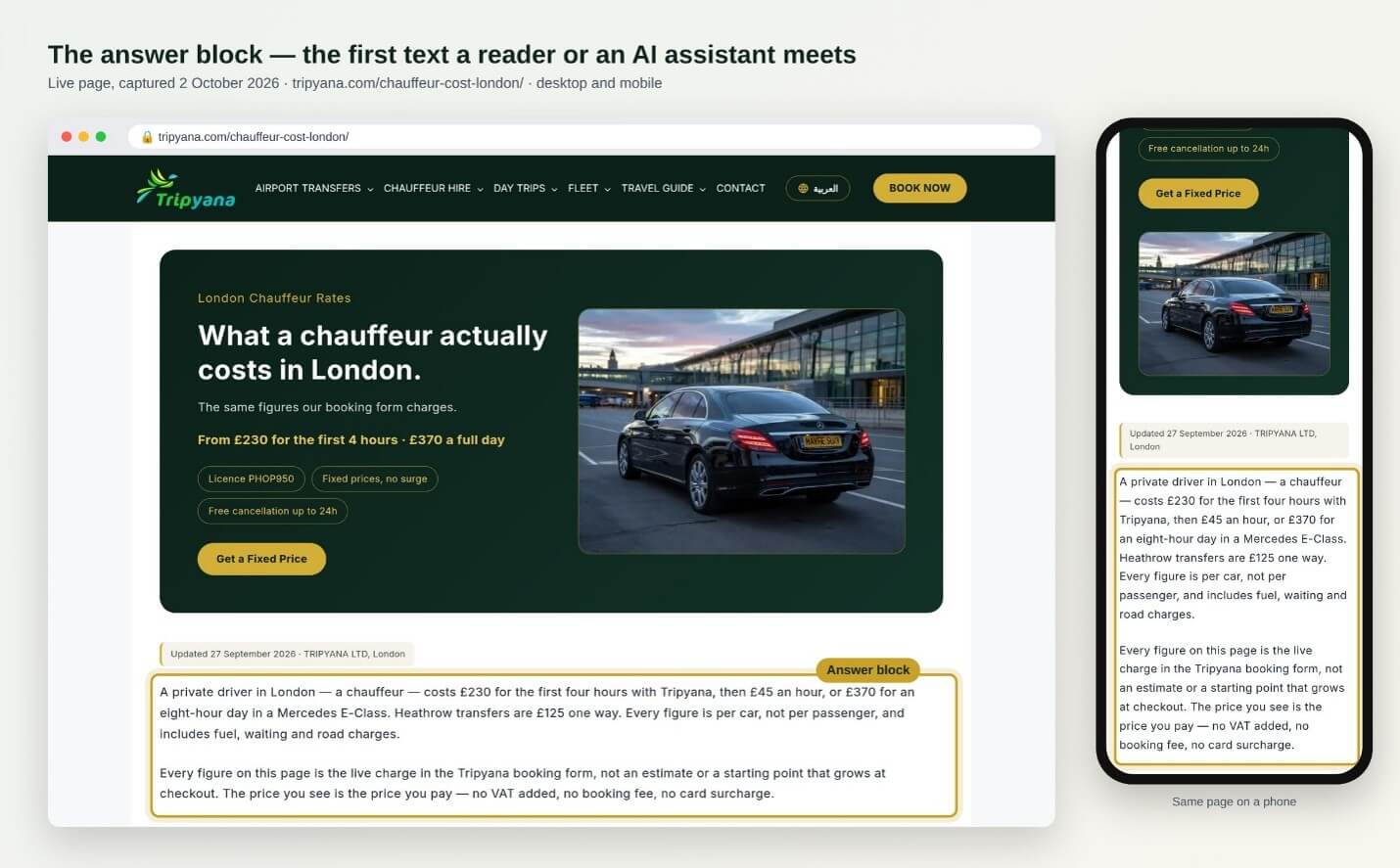
And there are eight FAQs lower down the page. Each question is intended to answer a different buying decision:
RESULTS
The page was only receiving an occasional visit sourced to ChatGPT. Now it averages ten per day.
By examining their raw server log and correlating a visit to an inquiry, the team discovered they were likely getting AI traffic before search traffic.
“A nine-day-old page of ours had four Google impressions and zero Google clicks. A ChatGPT visitor landed on it on 11 September, and a £570 enquiry followed on 13 September. The answer-engine channel produced revenue on a page Google had effectively not yet registered,” Mousa said.
In the age of SEO, most people started by ranking for the juiciest keywords. Like ‘car insurance.’
But time and experience would teach them, they were more likely to be successful if they focused on long-tail keywords that served their ideal customer. So instead of ‘car insurance,’ focusing on ‘full coverage car insurance for young drivers in Florida.’
Not only are you more likely to actually rank for a long-tail keyword, but when you ratchet down to who your company serve’s best, you are more likely to have an exclusive value proposition for that visitor and win a conversion.
Now, in the AI era, I would argue that it’s all long-tail. With AI, your prospect isn’t inputting a short and generic query like ‘car insurance.’ And frankly, even the long-tail keyword mentioned above could be on the more concise side for an AI query.
One practical aspect for your marketing is to avoid the generic, high-level book-report-style content. AI is less likely to cite your brand for that.
Go for the deep cuts. Create specific information well-tailored to the motivations of your ideal prospect.
One opportunity I heard an SEO tell me about to win favor from Google back in the day was to link to PDFs from authoritative (academic, government, etc.) websites.
I was reminded of that when I was pitched this next example. I think there is a very replicable idea here for our readers. If you have a product or service with a complex sale, there is likely deep information posted across the web that would be valuable to your ideal customer. But it is buried in long, dense PDFs.
If you can make that information more accessible and transparent, you have the chance to win over both the human and the machine.
BEFORE
Guides explained funding rules, which the team described as normal SEO content.
For example, here was a typical paragraph:
Short answer: the EU does not lend to you. It backs your bank. Under InvestEU the European Investment Fund signs guarantee agreements with local banks, guarantee institutions and microfinance providers, and those institutions lend to you on easier terms. We currently track 254 such intermediaries across the EU. You apply to one of them, not to Brussels.
AFTER
The team tried a new approach when creating a guide for Horizon Europe subcontractor costs. Every claim cited the regulation by page, with a deep link into the official PDF. The guide had 29 links.
Here’s a typical paragraph:
Subcontracting is not a general label for outside help. The Grant Agreement defines it narrowly: it is a contract for goods, works or services that are part of the action tasks described in Annex 1. If the work is not an action task, it is not subcontracting, whatever the invoice says (AGA, p. 30).
The citation (AGA, p. 30) links directly to the exact page of the Commission’s PDF.
“Honestly, I didn't do it for AI. I built the tool because I was sick of re-reading the same funding rules for every application, and citing the page was for my own sanity,” explained Robert Grabarevic, founder, Scalebiz. “A page number lets anyone check a claim in thirty seconds instead of searching a 400-page PDF.”
The team also included a line under the headline about when the source was last checked.
Creative Sample #4: Transparency line about sourcing under headline

RESULTS
The Horizon Europe subcontractor cost guide accounted for 91% (51 of 56) of the site’s Google generative AI results from August 25th to September 17th, 2026.
This article was distributed through the free MarketingSherpa email newsletter.
Related resources
Transparent Marketing, Part 2: How to earn the trust of a skeptical consumer... and machine (video replay, with slides and resource kit)
Transparent Marketing: How to earn the trust of a skeptical consumer (from 2003)
4 human skills that keep marketers valuable in the AI era
AI In Marketing: When AI gives buyers answers first, here’s how marketers win
How to make content AI-citable
Event Deck Debate: Lovable v. PPT
AI transparency
This is a human-conceived and -written article, assisted by AI. MECLABS AI was used to review source pitches for artificial intelligence usage, evaluate the credibility of potential sources, craft follow-up questions to sources, brainstorm the steps and advice in this article, create Open Graph and CMS thumbnail images, and provide copy-edit suggestions for the article.
Get Better Business Results With a Skillfully Applied Customer-first Marketing Strategy

The customer-first approach of MarketingSherpa’s agency services can help you build the most effective strategy to serve customers and improve results, and then implement it across every customer touchpoint.
Get More Info >MECLABS AI

Get headlines, value prop, competitive analysis, and more.
Use the AI for FREE (for now) >Marketer Vs Machine

Marketer Vs Machine: We need to train the marketer to train the machine.
Watch Now >Live, Interactive Event

Join Flint McGlaughlin for Design Your Offer on May 22nd at 1 pm ET. You’ll learn proven strategies that drive real business results.
Get Your Scholarship >Free Marketing Course

Become a Marketer-Philosopher: Create and optimize high-converting webpages (with this free online marketing course)
See Course >Project and Ideas Pitch Template

A free template to help you win approval for your proposed projects and campaigns
Get the Template >Six Quick CTA checklists

These CTA checklists are specifically designed for your team — something practical to hold up against your CTAs to help the time-pressed marketer quickly consider the customer psychology of your “asks” and how you can improve them.
Get the Checklists >Infographic: How to Create a Model of Your Customer’s Mind
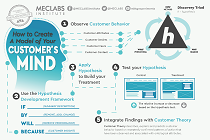
You need a repeatable methodology focused on building your organization’s customer wisdom throughout your campaigns and websites. This infographic can get you started.
Get the Infographic >Infographic: 21 Psychological Elements that Power Effective Web Design

To build an effective page from scratch, you need to begin with the psychology of your customer. This infographic can get you started.
Get the Infographic >